Primary vs. Secondary Market Research: Which One Do You Need?
Key Takeaways
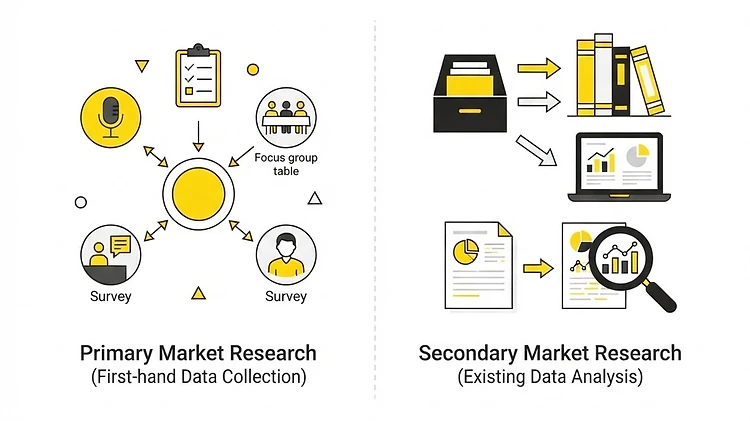
- Primary research is custom-collected, while secondary research uses pre-existing data.
- Qualitative research provides insights into 'why' consumers act, while quantitative data provides 'what' and 'how many'.
- Samples must be representative of the target audience to avoid bias.
- Market size calculations help determine the financial viability of a business idea.
Why Businesses Do Market Research
Imagine you decide to open 'Sunny Morning Cafe,' a cozy coffee shop in a quiet neighborhood. You have a great recipe for muffins, but that is not enough. You need to know if people in your neighborhood even drink coffee, how much they are willing to spend, and whether they prefer quick takeaway service or a lounge where they can study. Market research is your safety net. It helps you reduce uncertainty, spot potential risks, and identify opportunities before you spend your hard-earned savings on rent and equipment.
Primary Research: Getting Your Hands Dirty
Primary research is original data you collect specifically for your business. It is custom-made for your current problem. For 'Sunny Morning Cafe,' you might stand on the corner and interview locals, or email a survey to neighborhood group members. This gives you the freshest, most relevant information, but it is also time-consuming and expensive.
- Qualitative Data: This is about opinions and feelings. You might hold a focus group where neighbors explain why they dislike the nearby chain cafe. It gives you the 'why' behind consumer behavior.
- Quantitative Data: This is numerical. You count how many people pass your shop at 8:00 AM versus 10:00 AM. It tells you the 'how many.'
Secondary Research: Using Existing Resources
Secondary research is data that someone else has already collected. Think of government census reports, industry magazines, or competitor websites. It is usually cheaper and faster than primary research. You might look at local city records to see the population density or average income in your neighborhood to see if your price point makes sense. However, the data might be outdated or not specific enough for your unique business needs.
Sampling and Bias: Avoiding the Trap
You cannot survey everyone in the world, so you use a sample—a subset of your target market. If you only ask your best friends if they like your coffee, you have created 'sampling bias' because they will likely be too nice to tell you the truth. To get reliable data, you need a representative sample. If 60% of your neighborhood are students, then roughly 60% of your survey respondents should be students.
The Numbers: Calculating Potential Demand
Market research often involves calculating market size. Let's say you want to estimate your potential daily revenue. You discover through secondary research that there are 500 working professionals who pass by your cafe spot daily. Through your primary survey, you estimate that 20% of them would stop for a drink.
Formula: Estimated Demand = Total Target Population × Estimated Conversion Rate
Calculation: 500 people × 0.20 = 100 customers per day.
Interpretation: If 100 people buy a coffee for $4 each, you can expect a daily revenue of $400. This calculation helps you decide if your fixed costs, like rent, can be covered by your expected income.
Key Terms
- Primary Research: Original data collected first-hand for a specific business purpose.
- Secondary Research: Using data that has already been gathered by others for a different purpose.
- Qualitative Data: Non-numerical information that focuses on feelings, opinions, and motivations.
- Quantitative Data: Numerical data that can be measured and statistically analyzed.
- Sampling Bias: An error occurring when the sample collected is not truly representative of the total population.
Exam Tip: When an exam question asks you to recommend a research method, always evaluate the trade-off. Mention that primary research is more specific but costlier, while secondary research is quicker but potentially less relevant to your specific business scenario.
Market research isn't just about reading charts; it's about listening to your future customers so you can build something they actually want. Now, it is time for you to go out and test your own ideas—keep practicing your skills and you will find the answers you need!
Discussion Questions
- What is the fundamental difference between qualitative and quantitative market research methods?
- If you were launching a new subscription-based fitness app, would you prioritize primary or secondary research in the first month and why?
- To what extent is secondary research more reliable than primary research for a startup business?