The Product Life Cycle: Where Is Your Product and What Comes Next?
Key Takeaways
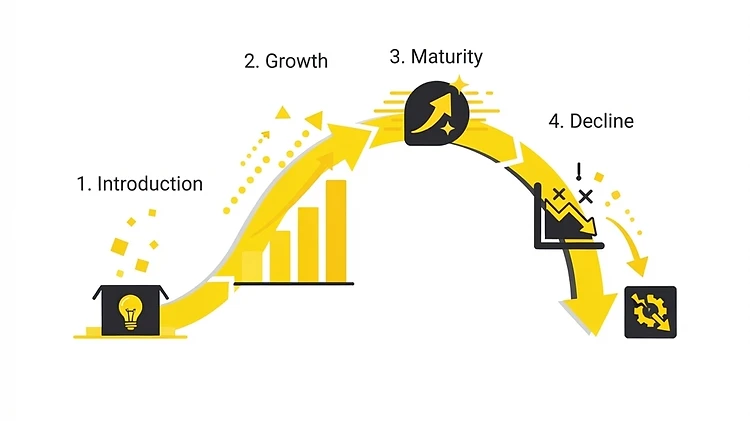
- The PLC tracks four stages: Introduction, Growth, Maturity, and Decline.
- Marketing strategies, especially pricing and promotion, must evolve as a product moves through each stage.
- Extension strategies are vital to prolonging a product's life during the maturity phase.
- Business leaders must decide between harvesting or divesting when a product enters the decline phase.
The Product Life Cycle: Where Is Your Product and What Comes Next?
Imagine you have just invented the 'Zen-Desk,' a self-organizing tray for office supplies that uses magnets to keep pens and paperclips perfectly aligned. As a business student, you are not just an inventor; you are a strategist. Understanding the Product Life Cycle (PLC) is like having a roadmap for your business journey. The PLC model tracks the sales of a product from its initial launch until it is eventually removed from the market. It consists of four distinct stages: Introduction, Growth, Maturity, and Decline.
The Journey of the Zen-Desk
When the Zen-Desk first hits the market in the Introduction stage, sales are low. You spend heavily on advertising to create awareness. Your pricing might be 'skimming'—charging a high price to early adopters to recoup development costs. Promotion is focused on 'informative' advertising; you are teaching people what your gadget actually does.
As customers start to rave about their tidy desks, the Zen-Desk enters the Growth stage. Sales climb rapidly. Competitors start to notice your success and may launch their own magnetic trays. You shift your pricing strategy to be more competitive and increase your promotional spend to build brand loyalty. Now, your ads focus on why your specific Zen-Desk is better than the copycats.
Eventually, you reach Maturity. Sales growth slows down and levels off. Most people who want a Zen-Desk already have one. Competition is fierce, often leading to price wars. This is where you might use 'extension strategies' to keep the product alive—perhaps launching a 'Zen-Desk Pro' in new colors or creating a subscription service for custom magnets.
Finally, the product enters Decline. Newer technologies or changing tastes mean people stop buying. Sales drop significantly. At this point, you must decide: do you 'harvest' the remaining profit with minimal effort, or do you 'divest' and pull the product off the shelves entirely to focus on a new invention?
Extension Strategies: The Math of Staying Relevant
To keep a product in the maturity phase longer, businesses use extension strategies. Imagine your company, Zen-Office Inc., currently sells 10,000 units per month. By releasing a 'Limited Edition Neon' version, you hope to increase sales by 15%.
Formula: New Sales = Current Sales * (1 + Growth Rate) Worked Example: 10,000 * (1 + 0.15) = 11,500 units.
This simple math shows you can effectively 'reset' the maturity phase by injecting new life into an aging product, preventing an early slide into decline.
Key Terms
- Product Life Cycle (PLC): The stages a product goes through from development to removal from the market.
- Extension Strategies: Marketing methods used to increase the life of a product and boost sales in the maturity stage.
- Skimming: Charging a high price during the introduction stage to maximize short-term profits.
- Maturity: The stage where sales stabilize and competition is at its peak.
- Divest: The decision to stop selling a product or exit a market.
Exam Tip: When discussing the PLC in your exam, always link your answer to the specific marketing mix (the 4Ps). For instance, emphasize how promotional tactics move from 'informative' in the early stages to 'persuasive' as competition increases in maturity.
Where do your favorites fit?
Take a moment to think about the products you use every day. Is that specific smartphone in its growth stage, or has it reached maturity? Perhaps a classic board game has been in the maturity phase for decades thanks to clever extension strategies like special anniversary editions. Look around your classroom or home—every object tells a story of where it sits on this curve.
Mastering these concepts takes time and observation, so keep analyzing the products around you. Practice, Practice, Practice!
Discussion Questions
- What are the four stages of the Product Life Cycle, and how does the promotional objective change from the introduction stage to the maturity stage?
- If a fictional company launches a high-tech kitchen appliance, what specific extension strategies could they implement to prevent the product from moving into the decline stage?
- Evaluate the necessity of extension strategies: To what extent is it always more beneficial to extend a product's life rather than launching a completely new one?