The Seven Ps of Marketing: A Practical Checklist for Any Business
Key Takeaways
- The 7Ps framework is essential for service-based businesses to ensure a consistent experience.
- People and processes are as important as the service itself in building customer loyalty.
- Physical evidence acts as a tangible signal of quality for intangible services.
- The marketing mix is not a static list but a strategic balancing act.
Mastering the Marketing Mix
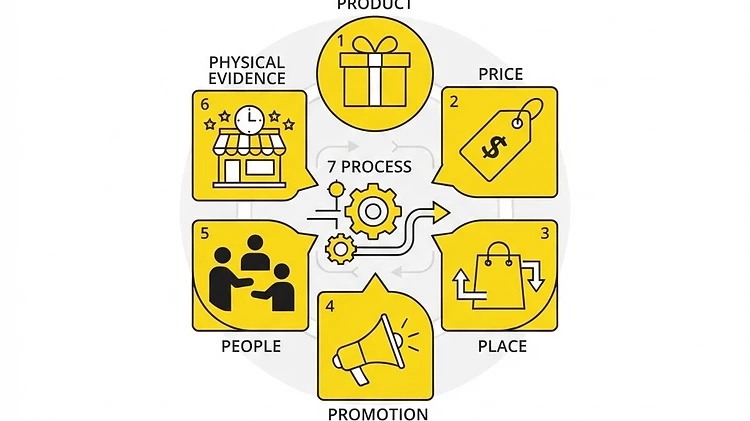
Marketing is often mistaken for just advertising, but it is actually a strategic balancing act. As an IB student, you need to look beyond the original 4Ps and master the 7Ps—a framework specifically designed for service-based businesses. To illustrate, let’s look at 'Silver Strand Studio,' a fictional local hair salon, and see how they turn these seven concepts into a successful reality.
The Product: The Service Itself
For a service, the 'product' is the experience. Silver Strand doesn't just cut hair; they provide a relaxing environment and expert consultation. They focus on quality control to ensure that every stylist provides a consistent result. The secret here is understanding that the customer isn't just buying a haircut; they are buying a boost of confidence.
The Price: Setting the Value
How much should Silver Strand charge? If they want to be a premium salon, they might use 'prestige pricing.' Let’s calculate their potential revenue per stylist. If a haircut costs $80 and a stylist does 5 cuts per day, the daily revenue is: Revenue = Price × Quantity = $80 × 5 = $400. This calculation helps the owner set financial goals to cover their rent and product costs.
The Promotion: Getting the Word Out
Promotion is how you tell the world you exist. Silver Strand uses a mix of social media 'before-and-after' photos and local community sponsorships. The goal is to build brand awareness so that when a local resident needs a trim, Silver Strand is the first name that pops into their mind.
The Place: Convenience and Access
In the service industry, 'Place' is about where the customer encounters the service. Silver Strand chose a location near the town’s main train station. This makes it easy for commuters to drop in after work, capturing a segment of the market that values convenience over everything else.
The People: The Human Element
In a salon, the staff is the brand. The stylists at Silver Strand are trained not just in technical skills, but in customer service and active listening. Because services are inseparable from the person providing them, the employees must be friendly, professional, and reliable. If a stylist is rude, the customer leaves, and the business loses more than just a single sale—they lose a repeat client.
The Processes: The Customer Journey
'Processes' refers to the systems in place to make the service run smoothly. Silver Strand uses an online booking system, a standard greeting ritual, and a clear consultation step before any scissors touch hair. By standardizing these steps, they ensure that every customer receives the same high-quality service, regardless of which stylist they visit.
The Physical Evidence: Tangible Cues
Since a haircut is an 'intangible' service, customers look for physical clues to judge quality. Silver Strand keeps their shop spotlessly clean, uses professional lighting, and offers high-end complimentary coffee. These physical elements reassure the customer that they are in a professional environment, justifying the price they pay.
Key Terms
- Intangibility: A service that cannot be touched, smelled, or held before purchase.
- Marketing Mix: The combination of elements used by a business to influence customer demand.
- Prestige Pricing: Setting a high price to create an image of quality or exclusivity.
- Service: An intangible product that involves the provision of labor or expertise.
Exam Tip
Exam Tip: When asked about the 7Ps, always explain how they work together rather than just defining them individually. A high-scoring answer links how 'People' influence 'Physical Evidence' to create an overall brand image.
Understanding these seven components gives you a powerful toolkit to evaluate any business model. Whether you are analyzing a local business or a multinational corporation, break it down by these seven pillars, and the marketing strategy will become crystal clear. Remember, you become a master of these concepts through constant application—keep identifying these Ps in the businesses you visit every single day!
Discussion Questions
- Define the 7Ps of the marketing mix and explain why the additional 3Ps were added for service-based businesses.
- If a service business like a hotel is struggling with poor customer reviews, how could they use the 'Processes' and 'People' elements to improve their position?
- Evaluate the importance of 'Physical Evidence' compared to 'Price' for a new, independent luxury spa entering a competitive market.