Why Biotech Products Take Years to Develop: R&D, Risk, and Reward
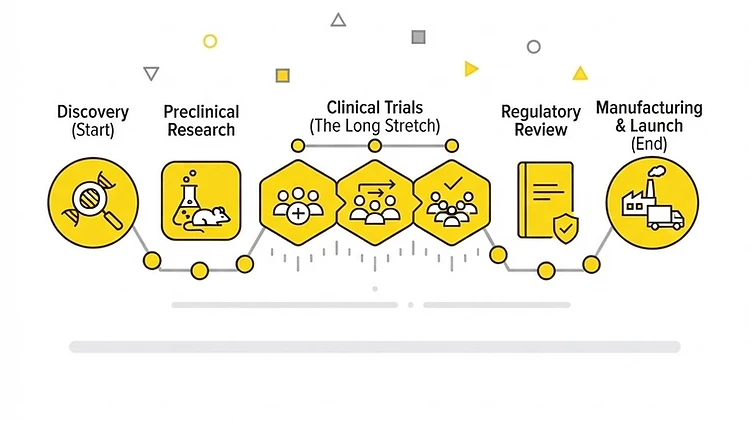
Key Takeaways
- R&D is essential for long-term growth but carries significant financial risk and uncertainty.
- Radical innovation offers high rewards but involves higher failure rates than incremental innovation.
- Patents provide the legal protection necessary for firms to recoup high sunk costs in R&D-heavy industries.
- The Payback Period is a vital tool for assessing whether an investment is viable within a company's financial timeframe.
The Long Game of Innovation: Inside a Biotech Startup
Imagine you are the CEO of 'AuraGenics', a tiny startup operating out of a shared lab. You have discovered a molecule that could revolutionize how we treat rare skin conditions. You are excited, your team is energized, but you are also staring down a decade-long path before your product ever touches a patient’s skin. In the high-stakes world of biotechnology, innovation is not just about having a bright idea; it is about managing massive financial risk and complex regulatory hurdles.
The Anatomy of R&D Intensity
For industries like biotech, Research and Development (R&D) is the oxygen of the business. R&D refers to the activities a firm undertakes to innovate and introduce new products or improve existing ones. Unlike a coffee shop that can iterate its menu in a week, 'AuraGenics' must conduct years of clinical trials to prove efficacy and safety. This is known as R&D intensity—the ratio of R&D spending to total revenue. Because the failure rate is incredibly high, firms must invest millions upfront with no guarantee of a return. This is the hallmark of 'heavy' R&D industries: high sunk costs, long lead times, and massive regulatory requirements.
Types of Innovation: Incremental vs. Radical
'AuraGenics' is banking on a 'radical innovation'—a brand new, breakthrough product that creates an entirely new market. This is contrasted with 'incremental innovation', which involves small, steady improvements to existing products. For instance, if another company, 'DermaFix', simply changes the packaging or scent of an existing cream, that is an incremental step. Radical innovation carries more risk but offers the potential for a 'first-mover advantage', allowing a company to set industry standards and capture market share before competitors even enter the field.
Calculating the Cost of Success
In business, we often look at the 'Payback Period' to understand how long it takes to recover an investment. For a startup, this is critical. Let’s look at a smaller project within 'AuraGenics'. They are investing $2,000,000 into a new lab module. They expect the module to generate $500,000 in net cash flow per year.
Formula: Payback Period = Initial Investment / Annual Cash Flow
Worked Example: $2,000,000 / $500,000 = 4 years.
Interpretation: This means the company will be 'in the red' for four years before this specific investment begins to contribute positively to the firm's overall profit. If the technology becomes obsolete in three years, the company will never recoup its costs. This highlights the danger of R&D: if the market changes, the investment is lost forever.
Why Risk Management Matters
Why do firms like 'AuraGenics' continue despite these daunting odds? The answer lies in the 'intellectual property' protection provided by patents. When a company develops a unique drug, they receive a patent, which grants them a temporary legal monopoly. This prevents competitors from copying the product, allowing the firm to charge a premium price to recoup those massive R&D costs. Without this protection, no investor would ever fund the decade of trials required to bring a safe product to market.
Key Terms
- R&D Intensity: A measure of how much a company spends on research and development relative to its total revenue.
- Sunk Costs: Expenditures that have already been made and cannot be recovered, even if a project is canceled.
- Radical Innovation: The development of a completely new product or service that transforms an industry.
- Payback Period: The length of time required to recover the cost of an investment.
- Intellectual Property: Legal rights, such as patents, that protect a company's innovations from being copied by rivals.
Exam Tip
Exam Tip: When evaluating R&D in an exam, always discuss the trade-off between the potential for high long-term profit and the immediate strain on cash flow. Never just mention the cost; connect it to the business's overall liquidity and survival risk.
In the world of business strategy, understanding the numbers is only half the battle; the rest is persistence. Remember, the best way to master these concepts is to practice, practice, practice!
Discussion Questions
- What is the difference between incremental and radical innovation in the context of the pharmaceutical industry?
- If a biotech firm like AuraGenics faces a sudden cash flow crisis, how might this impact their long-term R&D projects?
- Evaluate the necessity of government-granted patents for industries that require high levels of upfront R&D investment.