Financial vs. Non-Financial Rewards: What Really Motivates People?
Key Takeaways
- Financial rewards, like commissions, provide clear incentives for measurable tasks.
- Non-financial rewards focus on psychological needs, such as autonomy and growth.
- A hybrid approach is often the most effective way to ensure both high performance and long-term loyalty.
- The suitability of a reward depends heavily on the specific nature of the employee's role.
Introduction: The Motivation Puzzle
Every business leader wants to know the secret to a happy, productive team. Is it the size of the paycheck, or is it the office culture? As an IB Business Management student, you will learn that motivation is rarely one-dimensional. At its core, it is about understanding what drives an individual to perform at their best. Broadly, we categorize these drivers into financial and non-financial rewards.
The Power of the Paycheck: Financial Rewards
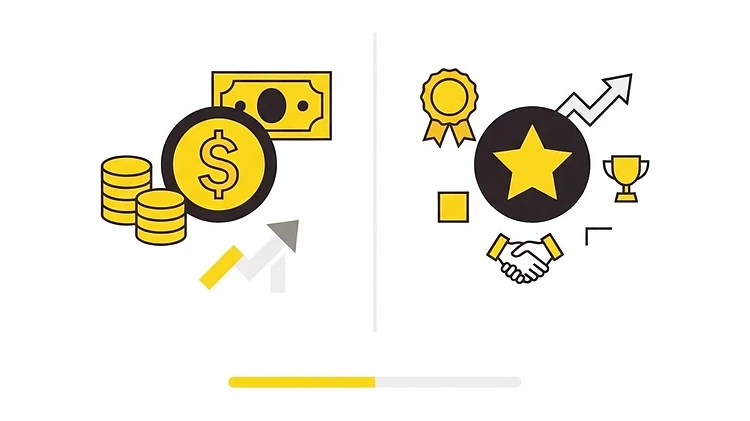
Financial rewards are direct monetary payments. For the sales team at 'SwiftGear Sales,' a fictional electronics retailer, the primary motivator is clearly financial. They operate on a commission-based structure. If a salesperson sells a laptop for $1,000 and earns a 5% commission, the calculation is simple: $1,000 * 0.05 = $50. This immediate feedback loop encourages them to close as many deals as possible. Other financial rewards include salaries, hourly wages, profit-related pay, and performance-related pay (PRP). The main advantage is that money is a universal need, providing security and the ability to fulfill basic lifestyle requirements. However, the limitation is that once basic needs are met, money often stops being the primary driver of high-level creativity or long-term loyalty.
Beyond Money: Non-Financial Rewards
Contrast the sales team with 'PixelPerfect Studios,' a fictional creative design firm. Their employees are highly skilled graphic designers who value autonomy and growth. Instead of heavy commissions, 'PixelPerfect Studios' offers non-financial rewards: flexible working hours, professional development courses, and the opportunity to lead their own creative projects. These rewards focus on psychological and social needs. They recognize that designers need inspiration and a sense of ownership over their work. When workers feel trusted and intellectually challenged, they often produce higher-quality output than they would if they were simply 'chasing the clock' for a bonus. The clear advantage here is improved retention and a stronger corporate culture, though it can be harder for managers to measure the direct return on investment for such rewards compared to a simple sales commission.
Calculating Financial Impact
To see how financial rewards work, consider a worker at 'SwiftGear Sales' who earns a base salary of $2,000 plus a performance bonus. The formula for total earnings is: Total Pay = Base Salary + (Units Sold * Commission Per Unit). If the worker sells 50 units and receives $10 per unit, their total pay is: $2,000 + (50 * $10) = $2,500. This result demonstrates how the business incentivizes high effort; the employee takes home 25% more money than their base salary by hitting their performance targets. It aligns the worker's personal financial goals with the company's revenue goals, creating a win-win scenario.
Comparing the Strategies
Financial rewards are excellent for roles where output is measurable and individual, such as sales or manufacturing. They provide clarity. However, if used in isolation, they can create a cut-throat culture where employees stop helping each other. Non-financial rewards, while harder to quantify, build the 'soft' infrastructure of a company. They foster loyalty, reduce stress, and encourage the kind of creative collaboration that money cannot buy. The most successful organizations often employ a hybrid approach—offering a fair base salary (financial) while layering on job enrichment and recognition programs (non-financial) to keep employees engaged for the long haul.
Key Terms
- Commission: A payment to an employee based on a percentage of the value of their sales.
- Performance-Related Pay (PRP): A payment system that rewards employees for meeting pre-set objectives.
- Job Enrichment: Giving employees more complex and challenging tasks to increase their sense of achievement.
- Fringe Benefits: Additional perks provided to employees beyond their salary, such as health insurance or company cars.
- Autonomy: The degree of freedom and independence an employee has in scheduling their work and determining procedures.
Exam Tip
Exam Tip: When discussing rewards, always link the type of reward to the specific job role. A salary is often best for stable, administrative roles, while performance-related pay suits target-driven roles like sales. Never suggest one method is universally 'best' without considering the nature of the business.
Finding the right balance between these rewards is the key to managing a successful team—always remember that practice, practice, practice!
Discussion Questions
- Identify three examples of non-financial rewards that a business might offer to improve employee morale.
- If a business like 'SwiftGear Sales' wanted to improve team collaboration, how might they adjust their current commission-based reward system?
- To what extent are non-financial rewards more effective than financial rewards in retaining highly creative employees at a firm like 'PixelPerfect Studios'?