Organizational Culture: Why Workplaces Feel So Different
Key Takeaways
- Culture is the shared values and norms that determine how employees behave.
- Cultural types include power, role, task, and person cultures.
- Mergers often fail due to the hidden friction of mismatched cultural norms.
- High staff turnover is a measurable sign of a toxic or mismatched culture.
What is Organizational Culture?
Think of organizational culture as the 'personality' of a business. Just as you have a unique way of reacting to stress, celebrating wins, or communicating with friends, a company has a set of shared values, beliefs, and norms that dictate how employees interact and perform. It is the unwritten rulebook—the invisible force that influences everything from how people dress to how they handle a customer complaint.
At the HL level, we recognize that culture is not just a poster on the wall. It is ingrained in the organizational structure. Some firms favor a hierarchical 'Power Culture,' where decision-making is centralized and rapid. Others embrace a 'Task Culture,' where teams form to solve specific problems and dissolve once the mission is complete. These cultural archetypes define whether a business feels like a rigid machine or a loose, creative network.
A Tale of Two Mergers: The Friction of Values
Let us imagine two fictional companies: NovaTech, a high-growth startup, and LegacyCorp, a century-old manufacturer. NovaTech operates with a 'Person Culture,' where autonomy is king, casual attire is mandatory, and failure is seen as a necessary step toward innovation. Employees rarely report to just one manager, and bureaucracy is kept to a minimum.
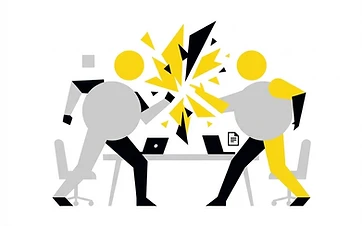
Now, imagine LegacyCorp decides to acquire NovaTech. LegacyCorp thrives on a 'Role Culture.' Everything there is defined by job descriptions, strict chains of command, and extensive documentation for every decision. When these two collide, the sparks fly. A NovaTech employee might be used to pitching an idea to the CEO over lunch. At LegacyCorp, they are told they must submit a formal proposal through three layers of middle management. The NovaTech employees feel stifled and suffocated, while the LegacyCorp staff view the newcomers as disrespectful and chaotic. This is a classic cultural clash, and it is the primary reason why many mergers fail to deliver the expected financial synergies.
Quantifying Cultural Impact: The Employee Turnover Rate
Cultural clashes often lead to high employee turnover. When people feel that their values no longer align with the organization, they leave. We can measure this using the staff turnover formula:
Formula: (Number of staff who left / Average number of staff employed) x 100
Worked Example: Suppose that in the six months following the merger, 40 employees left NovaTech. If the company employed an average of 200 staff during that period, the calculation is: (40 / 200) x 100 = 20%.
Interpretation: A 20% turnover rate in just six months suggests a massive retention crisis, likely caused by the friction between the NovaTech and LegacyCorp cultures. This turnover creates 'hidden costs,' including recruitment, training, and the loss of tacit knowledge, which eventually hits the firm’s bottom line.
The Challenge of Cultural Change
Changing a culture is notoriously difficult because it requires changing human behavior and deep-seated attitudes. Managers often fall into the trap of 'surface-level change'—changing the logo or moving desks—while ignoring the core rituals and systems that actually drive behavior. To successfully merge two cultures, leaders must identify the best traits of both, communicate the 'new' identity clearly, and lead by example. If the leadership team at LegacyCorp continues to act as if they are the only ones with a voice, the NovaTech culture will never integrate; it will simply be destroyed.
Key Terms
- Organizational Culture: The shared values and beliefs that influence the behavior of people in an organization.
- Power Culture: A system where power is concentrated among a few key individuals at the top.
- Role Culture: A structure based on clear job descriptions, formal rules, and specific hierarchies.
- Cultural Clash: The conflict that occurs when two distinct organizational values systems are forced to merge.
- Staff Turnover: The percentage of employees who leave an organization during a specific time period.
Exam Tip: When asked about culture in an exam, never describe it as just the dress code or office layout. Always link it to the 'deep' aspects: decision-making power, risk-taking, and communication styles. You will earn more marks by analyzing how these deep-seated traits affect strategy and operational performance.
Mastering these concepts requires an analytical eye, so keep applying your knowledge to real-world scenarios—practice, practice, practice!
Discussion Questions
- Define the four main types of organizational culture as identified by Charles Handy.
- How does a 'Role Culture' affect the decision-making speed of a company attempting to innovate?
- To what extent is the failure of a business merger primarily a result of cultural incompatibility rather than financial mismanagement?