How to Build a Cash-Flow Forecast, Step by Step
Key Takeaways
- A cash-flow forecast tracks the timing of money coming in and going out, not just accounting profit.
- The closing balance of one month must be the opening balance of the following month.
- Forecasting helps entrepreneurs identify cash shortages before they happen.
- Negative net cash flow does not always mean failure, but it requires careful management.
Mastering Cash-Flow Forecasts: Your Guide to Business Health
Imagine you are running a bustling food truck. You have ingredients to buy, staff to pay, and fuel for your generator. But what if a quiet week hits? Without cash in your pocket to cover the bills, your business could stall, even if you are technically 'profitable' on paper. This is why a cash-flow forecast is the most vital document for any entrepreneur.
Understanding the Basics
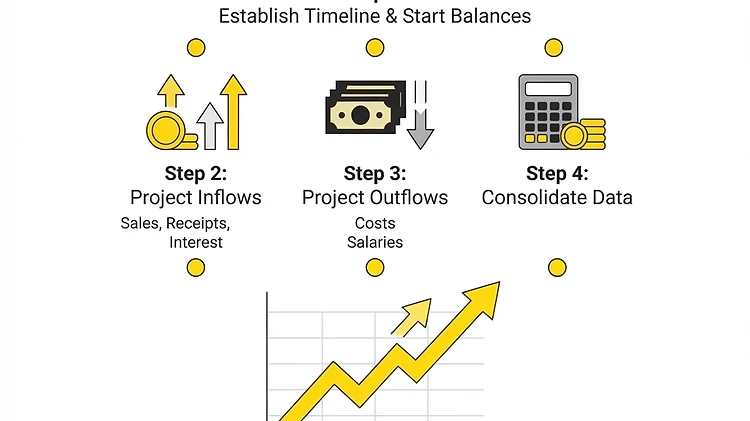
A cash-flow forecast is essentially a prediction of money moving into and out of your business over a specific time period. It tracks cash inflows (money received) and cash outflows (money paid out). The difference between these two is your net cash flow, and when added to your starting cash, it reveals your closing balance. It is not about profit; it is purely about the timing of liquid cash.
The Anatomy of a Forecast: The 'Taco-Go' Example
Let us look at 'Taco-Go', a food truck business I created to illustrate this. We are looking at a three-month forecast for the first quarter. To find net cash flow, use this formula: Net Cash Flow = Total Inflows - Total Outflows.
| Item | Month 1 ($) | Month 2 ($) | Month 3 ($) | | :--- | :--- | :--- | :--- | | Opening Balance | 500 | 800 | 1,200 | | Inflows (Sales) | 2,000 | 2,500 | 3,000 | | Outflows (Rent/Ingredients/Wages) | 1,700 | 2,100 | 2,200 | | Net Cash Flow | 300 | 400 | 800 | | Closing Balance | 800 | 1,200 | 2,000 |
In Month 1, Taco-Go started with $500. After subtracting the $1,700 in costs from the $2,000 in sales, the business had a net cash flow of $300. Adding that $300 to the opening balance gives a closing balance of $800. This $800 then becomes the opening balance for Month 2.
What does this tell us? It shows that the owner is managing costs effectively and the business is growing steadily. If the closing balance had dropped into the negative, the owner would know weeks in advance that they need to either boost sales or seek a short-term bank loan.
Why Forecasts Matter
Building a forecast forces you to think about the 'when.' You might sell 1,000 tacos in a month, but if your customers pay on credit 30 days later, you might have no money to pay your staff tomorrow. A forecast prevents these 'cash gaps.' It helps you identify seasonal trends, negotiate better payment terms with suppliers, and proves to banks that you have a plan for your finances. A business that fails to forecast is a business flying blind through a storm.
Key Terms
- Cash Inflow: Money entering the business, typically from sales or loans.
- Cash Outflow: Money leaving the business for expenses like rent, utilities, and wages.
- Net Cash Flow: The total cash inflow minus the total cash outflow for a specific period.
- Opening Balance: The amount of cash in the business at the start of the month.
- Closing Balance: The amount of cash in the business at the end of the month, carried over to the next period.
Exam Tip: When constructing a forecast in an exam, always remember that the 'Closing Balance' of one month must equal the 'Opening Balance' of the next. If your numbers do not link up, you will lose accuracy marks quickly.
Moving Forward
Remember, a forecast is a living document. It is not set in stone; it is a hypothesis you test every month. When your actual results differ from your forecast—and they will—it is a learning opportunity. Analyze why the sales were lower or why the costs spiked. Did you overspend on marketing? Did a supplier increase prices unexpectedly? By regularly reviewing your forecast, you transform raw data into actionable strategy.
Success in business finance isn't just about math; it is about foresight. By mapping out your future, you take control of your business destiny. Keep analyzing, keep adjusting, and remember that confidence comes from practice, practice, practice!
Discussion Questions
- What is the difference between net cash flow and the closing balance in a financial forecast?
- If a business has high profits but negative cash flow, how might a cash-flow forecast help the owner identify the problem?
- To what extent is a cash-flow forecast more useful than an income statement for a new small business?