Primary, Secondary, Tertiary, and Quaternary Sectors: Where Do Jobs Come From?
Key Takeaways
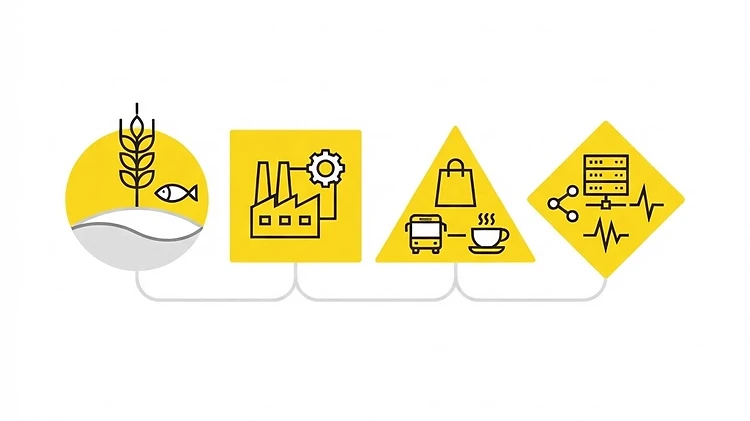
- The primary sector extracts raw materials from nature.
- The secondary sector involves manufacturing and assembling goods.
- The tertiary sector provides services to consumers and businesses.
- The quaternary sector focuses on information, technology, and intellectual services.
- Economic development often leads to a shift from primary-based industries to service-based ones.
Understanding the Business Lifecycle
Ever wonder where jobs actually come from? If you have ever looked at a smartphone, eaten a piece of fruit, or downloaded an app, you have interacted with the four sectors of business activity. Think of these sectors as a giant relay race of value. Businesses take raw materials, transform them, provide services, and finally, invent the knowledge that keeps the world moving forward. Let’s map out this journey.
The Primary Sector: Sourcing the Raw Materials
This is where it all starts. The primary sector involves the extraction and harvesting of natural resources. Without these businesses, we would have no materials to build anything. Think of "Evergreen Timber," a fictional company that manages sustainable forests to supply wood for furniture makers. Workers here might be loggers, miners, or farmers. It is the foundation of the economy, but as countries develop, they often rely less on this sector and more on others.
The Secondary Sector: Crafting and Creating
Once the primary sector collects the raw material, the secondary sector steps in to turn those materials into usable goods. This is manufacturing. Take "MetalEdge Gadgets," a company that buys raw aluminum to manufacture lightweight laptop cases. If you are building, refining, or assembling, you are in the secondary sector. This sector is usually the engine of industrial growth for developing nations.
The Tertiary Sector: The Service Experience
Most people today work in the tertiary sector. This sector doesn't produce physical goods; it provides services. If you visit "SwiftShift Delivery," a local courier firm, they are not making the box; they are moving it to your door. This sector includes retail, banking, tourism, and healthcare. As economies prosper, the demand for services like entertainment and education explodes.
The Quaternary Sector: The Knowledge Hub
This is the newest frontier. The quaternary sector focuses on intellectual activities—information technology, scientific research, and data analysis. Imagine "BrainWave Solutions," a company that uses artificial intelligence to predict market trends for other businesses. They do not manufacture goods or just provide basic services; they create value through high-level thinking and digital innovation.
How Economies Evolve
Economies shift over time through a process called structural change. In the early stages, most people work in the primary sector. As technology improves, we need fewer people to farm, so they move to the secondary sector. Eventually, as wealth increases, people demand more services, leading to a massive expansion of the tertiary and quaternary sectors. This shift is how societies progress from agrarian roots to high-tech digital powerhouses.
Measuring Sector Performance
Businesses often track their performance to see if they are expanding. A common metric is market share. Let’s look at "QuickBite Cafes," a local chain in the tertiary sector. If the total market revenue for coffee shops in town is $1,000,000, and QuickBite earns $250,000, their market share is calculated as:
Formula: (Individual Company Revenue / Total Market Revenue) x 100 Calculation: ($250,000 / $1,000,000) x 100 = 25%
This result means that QuickBite captures exactly one-quarter of the local coffee market, signaling a strong brand presence.
Key Terms
- Primary Sector: Businesses involved in the extraction or harvesting of raw materials from nature.
- Secondary Sector: Businesses that process or manufacture raw materials into finished or semi-finished goods.
- Tertiary Sector: The segment of the economy that provides services to consumers and other businesses.
- Quaternary Sector: A subset of the tertiary sector focused on knowledge-based services, research, and information technology.
- Structural Change: The long-term shift in the proportion of output or employment across the four business sectors.
Exam Tip: When discussing economic change, remember that these sectors are interconnected. A smartphone relies on mining (primary), assembly (secondary), retail sales (tertiary), and software development (quaternary) to function.
Whether you are designing the next big app or harvesting grain, every sector plays a vital role in our global business ecosystem. Keep exploring how these pieces fit together—and remember, practice, practice, practice!
Discussion Questions
- Can you identify which sector of the economy would be most affected by a sudden global shortage of raw timber?
- If a local farming business begins selling their own produce directly to consumers via an app, how are they changing their sector involvement?
- Evaluate the impact of a transition from a secondary-sector-led economy to a quaternary-sector-led economy on a country's workforce.