Sources of Finance for Startups: Internal vs. External
Key Takeaways
- Internal finance like personal funds minimizes debt but increases personal risk.
- Debt finance (loans) requires interest payments but keeps ownership intact.
- Equity finance (shares) provides cash without interest but dilutes ownership control.
- Crowdfunding is a modern way to raise capital while building a customer base simultaneously.
Choosing Your Capital: The Startup Dilemma
Starting a business is like embarking on a long sea voyage. You need a sturdy boat, supplies, and a map, but most importantly, you need fuel. In the world of business, that fuel is finance. Whether you are launching a neighborhood dog-walking service or the next big mobile app, understanding where your money comes from is a fundamental skill for every entrepreneur.
Internal Sources: Using What You Have
Internal sources of finance come from within the business itself. This is often the first place founders look because it means you don't have to report to a bank or give away a piece of your company.
Personal funds are the most common starting point. Consider 'Zoe’s Zesty Bites,' a fictional meal-prep service. Zoe decided to invest $5,000 of her own savings to buy her initial kitchen equipment and ingredients. By using her own cash, she avoided debt, but she also took on 100% of the financial risk. If the business fails, that money is gone for good.
Retained profit and the sale of assets are other options. Retained profit is the money a business keeps after paying all expenses and taxes, while selling assets—like an old delivery van you no longer need—converts stagnant equipment into liquid cash you can use to grow.
External Sources: Bringing in Outsiders
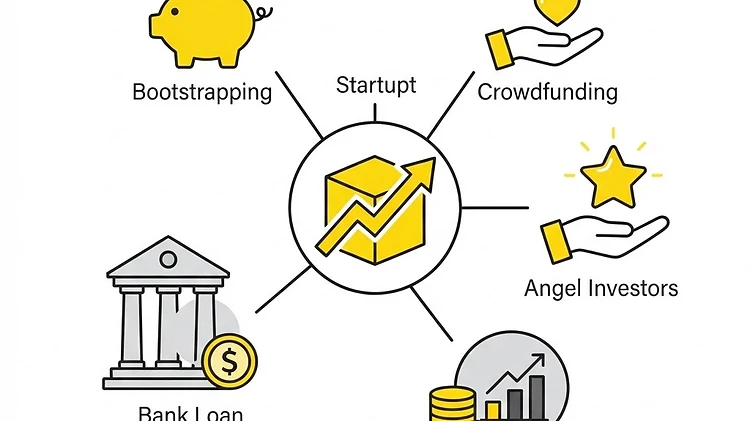
When internal sources aren't enough, you look outward. External sources include debt (money you owe) and equity (money you trade for a share of ownership).
Let’s look at how our entrepreneur Zoe might expand her business. She needs $20,000 for a new industrial oven. She could take a bank loan, issue share capital to a friend, or use crowdfunding.
If Zoe takes a loan of $20,000 at a 5% interest rate per year, she calculates her cost. Formula: Interest = Principal × Rate × Time. Calculation: $20,000 × 0.05 × 1 year = $1,000 in interest costs. This means the oven actually costs her $21,000 by the end of the year. The advantage is that she keeps full ownership, but she has a mandatory monthly payment regardless of how many meals she sells.
Alternatively, Zoe could choose crowdfunding. Through a platform like 'LaunchStarter,' she invites members of the public to pre-order her future meal kits. If she raises the $20,000 this way, she isn't borrowing money; she is essentially selling her future product. She avoids debt but faces immense pressure to fulfill those orders on time.
Finally, she could offer share capital. She gives 20% of 'Zoe’s Zesty Bites' to an investor in exchange for that $20,000. She gains the cash without interest, but she now has to share her future profits and lose some control over her decision-making.
Key Terms
- Retained Profit: Net profit reinvested back into the business rather than being paid out as dividends.
- Share Capital: Finance raised by selling shares in the company, representing partial ownership.
- Overdraft: A banking service that allows a business to spend more than its current account balance up to a limit.
- Crowdfunding: Raising small amounts of capital from a large number of people, usually via the internet.
Exam Tip
Exam Tip: When choosing a source of finance, always evaluate the 'cost' of the capital. Debt finance incurs interest payments that must be paid regardless of profit, while equity finance avoids interest but involves a permanent loss of control or share of future wealth.
Ultimately, there is no 'perfect' source of finance. The right choice depends on the scale of your project, your willingness to take on debt, and how much control you are ready to share. Just like learning any new skill, understanding these financial tools takes time, so keep refining your strategy as you go. Practice, Practice, Practice!
Discussion Questions
- Identify two differences between internal and external sources of finance.
- If a business needs to upgrade equipment immediately but has no savings, explain one advantage and one disadvantage of using an overdraft versus a bank loan.
- Evaluate the decision for a new entrepreneur to use personal savings versus seeking venture capital funding for a high-growth tech startup.