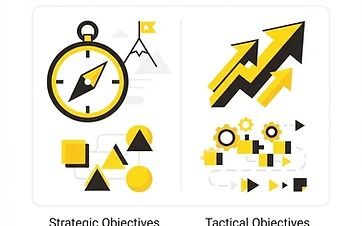
Strategic vs. Tactical Objectives: Why Profit Isn't the Only Goal

Key Takeaways
- Strategic objectives are long-term, high-level goals that define the business's direction.
- Tactical objectives are short-term, specific steps used to achieve the overarching strategy.
- Businesses balance multiple objectives, such as growth, survival, and social responsibility, rather than focusing solely on profit.
- Objectives should be SMART to be effective for business planning and evaluation.
The North Star and the Map: Strategic vs. Tactical Objectives
Imagine you are running 'The Paper Lantern,' a cozy, independent bookstore in the heart of a bustling city. You want the shop to thrive, but what does 'thriving' actually mean? Is it selling as many books as possible? Keeping the shelves stocked? Making sure the coffee in the back corner tastes like heaven? In business management, we define these desires as objectives—the specific, measurable goals that help a firm achieve its mission.
However, not all objectives are created equal. To run a successful business, you must distinguish between your strategic objectives (your long-term 'North Star') and your tactical objectives (the map you use to get there).
The Big Picture: Strategic Objectives
Strategic objectives are the high-level goals set by senior leadership. They usually cover a period of three to five years and define the very identity of the organization. They are the 'what' and 'why' of your business. For The Paper Lantern, a strategic objective might be: 'To become the region’s primary hub for independent literature by 2028.'
These objectives often focus on themes like corporate social responsibility, brand reputation, or long-term growth. Because they are long-term, they involve high-stakes decisions and significant investment. If the strategy is wrong, the entire business can suffer, which is why they are often linked to the core mission statement of the firm.
The Daily Grind: Tactical Objectives
If the strategic objective is the destination, tactical objectives are the daily or weekly steps you take to arrive there. These are short-term, specific, and often departmental goals. A tactical objective at The Paper Lantern might be: 'Increase the number of monthly loyalty club sign-ups by 15% over the next quarter.'
Tactical objectives are essentially building blocks. By achieving a series of small, tactical wins, the business gradually edges closer to its massive, long-term strategic goal. They are usually set by middle managers and focus on efficiency, resource allocation, and hitting immediate targets.
More Than Just Profit
While profit is essential for survival, it is rarely the only objective. Businesses often have multiple goals that balance each other. Consider these common types:
- Growth: Increasing market share or opening new locations.
- Survival: Keeping the business alive during a recession or tough competition.
- Corporate Social Responsibility (CSR): Reducing the business's carbon footprint or supporting local charities.
- Efficiency: Maximizing output while minimizing waste.
A Worked Example: The Numbers
Let us look at a tactical objective calculation. The Paper Lantern wants to measure their sales efficiency. They set a tactical objective to increase their 'Profit Margin' on bookstore events.
The Formula: (Net Profit / Revenue) x 100 = Profit Margin Percentage.
The Scenario: Last month, the store hosted an author signing event. The event generated $2,000 in revenue but cost $1,500 to host (including staffing and materials).
Calculation: ($2,000 - $1,500) = $500 Profit. ($500 / $2,000) x 100 = 25% Margin.
Interpretation: This 25% margin is a tactical indicator. If the store's strategic goal is to increase overall profitability by 5% annually, they can use these individual event margins to decide which types of events to host more frequently.
Key Terms
- Mission Statement: A brief, overarching statement of why a business exists.
- Strategic Objective: A long-term goal that defines the direction of the whole organization.
- Tactical Objective: A short-term, specific goal designed to help achieve a strategy.
- Market Share: The percentage of total sales in an industry generated by a particular company.
- Corporate Social Responsibility: The obligation of a business to act ethically and contribute to society.
Understanding the Hierarchy
When you think about business objectives, visualize a ladder. Your mission statement is the top of the building you want to reach. Your strategic objectives are the rungs of the ladder, while your tactical objectives are the movements of your feet as you climb one step at a time. Without the rungs, you cannot reach the top; without the movement, you remain stuck on the ground.
Exam Tip: When an exam question asks about objectives, always consider the SMART criteria: Specific, Measurable, Achievable, Relevant, and Time-bound. Vague goals like 'we want to do better' are not objectives; specific goals with deadlines are.
Ultimately, businesses that succeed are those that keep their eyes on the horizon while ensuring their feet are moving in the right direction every single day. Mastery comes from consistency, so keep reviewing these concepts and applying them to new scenarios. Practice, Practice, Practice!
Discussion Questions
- Define the difference between a strategic objective and a tactical objective using your own example.
- If a business decides to prioritize survival, how might that tactical objective conflict with a long-term strategic goal of expansion?
- Evaluate the importance of balancing profit-based objectives with Corporate Social Responsibility objectives for a modern business.