Fixed, Variable, Direct, Indirect: Understanding Your Costs
Key Takeaways
- Fixed costs stay constant while variable costs change with production output.
- Direct costs are easily traced to specific products, while indirect costs support overall operations.
- Total cost is the sum of total fixed costs and total variable costs.
- Correct cost classification allows for better pricing and smarter expansion decisions.
Mastering the Basics of Costing
Welcome, business students! If you have ever wondered why a business needs to track every single cent, you have come to the right place. In IB Business Management, understanding how a company spends its money is the foundation for almost every decision a manager makes. Let us explore the world of costs using a local favorite: 'Luigi’s Late-Night Pizza.'
Fixed vs. Variable: The Volume Connection
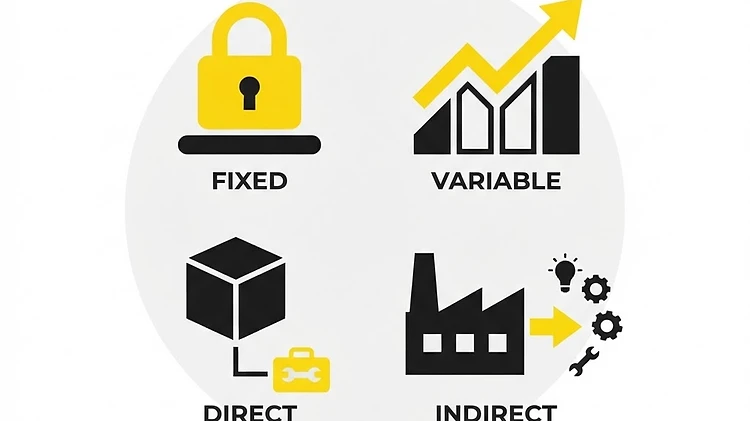
The most important distinction to make is between fixed and variable costs. Fixed costs are expenses that do not change based on how much you produce. Think of these as your 'keep the doors open' expenses. For Luigi, his monthly shop rent is $2,000. Whether he sells one pizza or a thousand pizzas, the landlord expects that same check.
Variable costs, on the other hand, change directly with the level of output. If Luigi sells more pizzas, he needs more pepperoni, mozzarella, and cardboard boxes. If he sells nothing, his variable costs drop to zero. If each pizza costs Luigi $3 in ingredients, that $3 is a variable cost.
Direct vs. Indirect: The Tracking Test
Next, we look at traceability. Direct costs are expenses that can be specifically linked to one particular product or service. The dough and sauce used on a pepperoni pizza are direct costs because we know exactly which product consumed them.
Indirect costs—often called overheads—are costs that support the business but cannot be traced to a single item. For Luigi, the salary of the shop’s accountant or the cleaning supplies for the lobby are indirect. He knows he needs them to operate, but he cannot say exactly how much of a bottle of floor cleaner went into a single slice of pizza.
Calculating Total Cost
To see the full picture, managers look at Total Cost (TC). The formula is simple:
TC = Total Fixed Costs (TFC) + Total Variable Costs (TVC)
Let’s run the numbers for Luigi’s shop for one month. Suppose Luigi sells 1,000 pizzas. His fixed costs are $2,000 (rent) + $500 (insurance) = $2,500. His variable costs per pizza are $3.
Total Variable Costs = $3 * 1,000 = $3,000.
Total Cost = $2,500 + $3,000 = $5,500.
This tells Luigi that to keep the doors open and fulfill 1,000 orders, he must spend $5,500. If his revenue is lower than this, he is losing money. Knowing this number is the first step toward setting a profitable menu price.
Why Does This Matter?
If you do not classify your costs correctly, you are flying blind. When a business understands which costs are fixed and which are variable, it can make better decisions about growth. For instance, if Luigi wants to expand, he knows his fixed costs will likely rise (a bigger store), but his variable costs might decrease if he buys ingredients in bulk.
Key Terms
- Fixed Costs: Expenses that remain constant regardless of output levels.
- Variable Costs: Expenses that increase or decrease in proportion to production volume.
- Direct Costs: Costs clearly identifiable with the production of a specific good.
- Indirect Costs: Overhead expenses that support overall business operations rather than a single product.
- Total Cost: The sum of all fixed and variable expenses incurred during a specific period.
Exam Tip: When an exam question asks you to calculate total costs, always ensure you multiply your variable cost per unit by the total number of units produced before adding the fixed costs. Many students forget this step!
Understanding these fundamentals is the secret sauce to becoming a great manager; keep analyzing those numbers and practice, practice, practice!
Discussion Questions
- Define the difference between a direct cost and an indirect cost.
- If Luigi’s Pizza decides to offer delivery, how would this change the nature of his variable and indirect costs?
- Evaluate the importance of cost classification for a startup business compared to an established multinational corporation.