Liquidity Ratios: Can This Business Pay Its Bills?

Key Takeaways
- Liquidity measures a firm's ability to pay off short-term debts.
- The current ratio provides a broad view of liquidity including inventory.
- The acid test ratio offers a stricter, more realistic view by excluding inventory.
- Businesses can improve liquidity by selling stock, managing debtors, or renegotiating payment terms.
The Hidden Danger of Retail Liquidity
Imagine you own 'Glimmer Gear,' a trendy boutique that sells high-end winter coats. Business is booming, and your shelves are packed with inventory. When you look at your balance sheet, your accountant tells you the business is in great shape. But are you actually as safe as you look? In the world of business management, liquidity refers to the ability of a business to pay its short-term debts. If you cannot pay your suppliers or your electricity bill on time, your business will grind to a halt, regardless of how much profit you have on paper.
The Current Ratio: The Big Picture
To check your health, we use the Current Ratio. It measures if you have enough current assets (cash, inventory, and money owed by customers) to cover your current liabilities (bills due within a year).
Formula: Current Ratio = Current Assets / Current Liabilities
Let’s look at Glimmer Gear. You have $100,000 in current assets and $50,000 in current liabilities. Calculation: $100,000 / $50,000 = 2.0. This means for every $1 of debt, you have $2 of assets. In many industries, a ratio between 1.5 and 2.0 is considered healthy. Everything looks perfect, right? Not quite.
The Acid Test Ratio: The Reality Check
The problem with the current ratio is that it assumes you can sell all your inventory instantly. If you are a coat shop in the middle of a hot summer, that inventory is just taking up space. It is not liquid cash. Enter the Acid Test Ratio, which subtracts inventory from the equation to see if you can pay your bills right now.
Formula: Acid Test Ratio = (Current Assets - Inventory) / Current Liabilities
Let’s revisit Glimmer Gear. Out of your $100,000 in current assets, $80,000 is tied up in winter coats that are not selling. That leaves only $20,000 in cash or short-term receivables. Calculation: ($100,000 - $80,000) / $50,000 = 0.4.
Suddenly, the story changes! A ratio of 0.4 means you only have 40 cents for every dollar you owe. If your suppliers demanded payment today, you would be in trouble. This is why looking at both ratios is vital; the first gives you a broad overview, while the second reveals your immediate survival capacity.
Strategies to Improve Liquidity
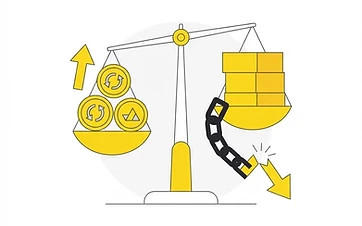
If you find your liquidity is low, you need to act fast. Here are three practical ways to improve your situation:
- Sell off slow-moving inventory: Hold a flash sale to turn that frozen stock into cold, hard cash.
- Delay payments to suppliers: Negotiate longer credit terms so you have more time to pay your bills without damaging relationships.
- Chase your debtors: Encourage customers who owe you money to pay early by offering a small discount for immediate payment.
Key Terms
- Current Assets: Items owned by a business that can be turned into cash within one year.
- Current Liabilities: Debts that must be paid by the business within one year.
- Liquidity: The ease with which an asset can be converted into cash to pay off immediate debts.
- Inventory: The stock of goods or materials held by a business to be sold to customers.
Exam Tip: When analyzing ratios in an exam, never just state the numbers. Always interpret what the figure means for the business's ability to survive in the short term, and link your answer back to the specific context provided in the case study.
Business finance might seem like a maze, but once you master these simple formulas, you hold the map to your own success. Keep at it, and soon this will be second nature—Practice, Practice, Practice!
Discussion Questions
- What is the fundamental difference between the current ratio and the acid test ratio in terms of what they measure?
- If a business has a high current ratio but a very low acid test ratio, what does this suggest about the nature of its inventory?
- Evaluate the potential risks of a business attempting to boost its liquidity by drastically reducing its inventory levels.