Lean Production: Doing More With Less
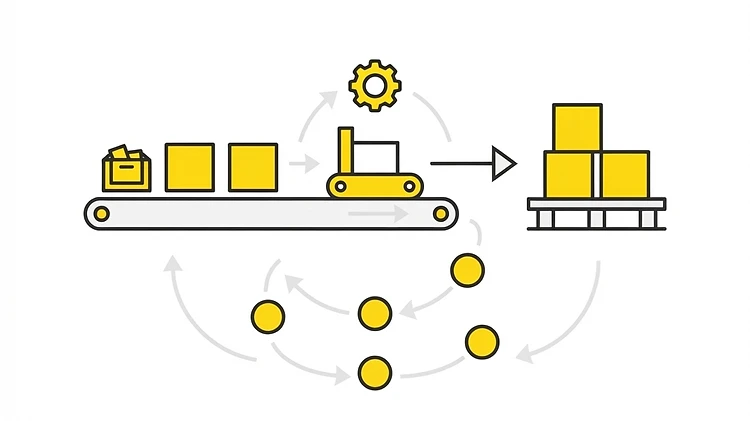
Key Takeaways
- Lean production focuses on the relentless elimination of 'muda' or waste.
- Techniques like Kaizen, JIT, and Andon improve efficiency and quality.
- Cycle time analysis is a critical metric for measuring production improvements.
- Lean offers significant cost savings but increases sensitivity to supply chain failures.
Lean Production: Doing More With Less
Imagine you own 'Velocity Bikes,' a custom bicycle manufacturer. You have a factory floor filled with boxes of frames, half-finished handlebars, and piles of unused rubber tires. Every square meter occupied by these idle materials is wasted space, and every second spent moving them around is a cost that adds no value for your customers. This is the exact scenario that Lean Production aims to solve. Lean is not just about cutting costs; it is a philosophy of maximizing value by relentlessly eliminating waste.
The Core Principles
At its heart, Lean is about efficiency. In the IB Business Management world, we define waste—or 'muda'—as any activity that does not add value to the final product. At Velocity Bikes, if a worker is waiting for a frame to arrive from another department, that is waste. If they are walking across the workshop to find a wrench, that is waste. Lean focuses on streamlining these processes so that only the necessary work is done.
Methods of Lean Production
To become 'Lean,' Velocity Bikes might adopt several specific techniques. First, there is 'Kaizen,' or continuous improvement. This means empowering every employee—from the assembly line technician to the painter—to suggest small, incremental changes to the daily workflow. Instead of waiting for a massive overhaul, you fix the small things every single day.
Second, consider 'JIT' (Just-in-Time). Rather than stocking three months of bicycle chains in your warehouse, you arrange for your supplier to deliver exactly what you need exactly when you need it. This slashes storage costs and prevents your cash from being trapped in dead stock.
Third, implement 'Andon' systems. This is a visual signaling system where a worker can pull a cord to stop the entire production line if they spot a quality defect. It seems counter-intuitive to stop production, but it ensures that errors are fixed immediately rather than building up thousands of faulty bikes.
A Worked Example: Calculating Efficiency
To see the impact of Lean, let's look at a 'Cycle Time' calculation. Cycle time is the total time elapsed from the beginning to the end of a process.
Formula: Cycle Time = (Total Available Time / Output Quantities)
At Velocity Bikes, your team was producing 20 custom frames in an 8-hour shift (480 minutes). Initial Cycle Time = 480 minutes / 20 frames = 24 minutes per frame.
After introducing Lean methods like 'Cellular Manufacturing' (grouping machines for each model type), you now produce 30 frames in that same 8-hour shift. New Cycle Time = 480 minutes / 30 frames = 16 minutes per frame.
Interpretation: By reducing the cycle time by 8 minutes per unit, you have increased your production capacity by 50% without adding new staff or machinery. This allows you to meet market demand faster and increase profit margins significantly.
The Benefits and Risks
The benefits are clear: reduced inventory costs, improved quality, and a more engaged workforce who feel their input actually changes the shop floor. However, there are significant risks. JIT relies entirely on your suppliers. If a strike occurs at your tire supplier, or a delivery truck breaks down, your entire factory at Velocity Bikes could grind to a halt because you have no 'buffer' of spare parts. Lean is fragile; it requires high trust and perfect coordination.
Key Terms
- Kaizen: The philosophy of continuous, small-scale improvements made by all staff members.
- JIT: An inventory strategy where materials arrive exactly when needed for production.
- Muda: The Japanese term for waste; any action that does not add value for the customer.
- Andon: A visual control system that alerts staff to problems, such as quality issues, in real-time.
Exam Tip: When discussing Lean in an evaluation question, always mention the trade-off between the efficiency gains of JIT and the risk of supply chain disruption. High-scoring answers recognize that Lean is a double-edged sword.
Becoming a business expert is a journey that requires constant refinement. To master these concepts, keep analyzing real-world businesses through a Lean lens—Practice, Practice, Practice!
Discussion Questions
- What is the difference between Kaizen and traditional top-down management in terms of process improvement?
- How might an Andon system change the organizational culture of a factory floor?
- Evaluate the suitability of Just-in-Time inventory for a company operating in a highly volatile, globalized market.