Quality Control vs. Quality Assurance: Total Quality Management Explained
Key Takeaways
- Quality Control is reactive and inspection-based, whereas Quality Assurance is proactive and process-based.
- TQM creates a culture where every employee takes ownership of quality standards.
- Poor quality creates significant financial waste that can be quantified through cost analysis.
- Kaizen, or continuous improvement, is a core pillar of maintaining long-term competitiveness.
The Art of Perfection: Quality in Business
Imagine walking into 'Sunrise Sourdough,' a local bakery that has built a reputation for the perfect crust. Lately, however, customers are complaining that some loaves are burnt while others are undercooked. This is a classic quality management crisis. For a business, quality is not just a buzzword; it is a strategic necessity that determines customer loyalty and long-term viability. To fix their inconsistency, the owners of Sunrise Sourdough must distinguish between Quality Control (QC), Quality Assurance (QA), and the holistic approach known as Total Quality Management (TQM).
Quality Control: The Safety Net
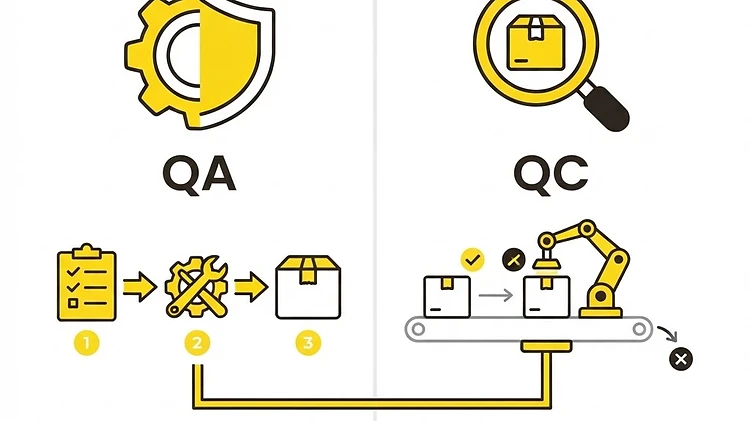
Quality Control is reactive. It is the process of inspecting products at the end of the production line to ensure they meet a set standard. At Sunrise Sourdough, QC involves the baker slicing a loaf open after it cools. If the texture is gummy or the crust is too dark, that loaf is discarded. While this prevents a bad product from reaching the customer, it is inherently wasteful. You have already spent the flour, the electricity, and the labor time only to toss the result in the trash.
Quality Assurance: The Blueprint
Quality Assurance is proactive. It focuses on the processes that create the product, rather than the product itself. The team at Sunrise Sourdough decides to install precise digital timers, standardized measurement scales for ingredients, and a rigorous training manual for new staff. By documenting every step of the process and ensuring the oven temperature is calibrated daily, they are building quality into the system. QA reduces waste because it prevents errors before they happen.
Total Quality Management: A Culture of Excellence
Total Quality Management (TQM) is the philosophy that every single person in the organization, from the dishwasher to the CEO, is responsible for quality. It is not just about tools; it is about mindset. If a delivery driver notices the flour sacks are being stored in a damp corner, a TQM culture empowers that person to suggest a solution before the humidity affects the bread’s rise. TQM involves concepts like Kaizen, or continuous improvement, where small, incremental changes are made daily.
Measuring Success: The Cost of Quality
To understand the financial impact, let us look at the cost of poor quality. Suppose Sunrise Sourdough produces 1,000 loaves a week. They currently waste 50 loaves due to errors. If it costs $2.00 to make each loaf and they sell them for $6.00, we can calculate the impact of their current quality failures.
Formula: Total Cost of Poor Quality = (Number of Failed Units) x (Cost per Unit)
Calculation: 50 loaves x $2.00 = $100 per week.
In one year (52 weeks), this is $5,200 in wasted production costs alone, not accounting for the lost revenue or the damage to their brand reputation. By implementing QA and TQM, if they reduce their failure rate to just 5 loaves per week, they save $4,600 annually in production costs, effectively boosting their net profit directly.
Key Terms
- Quality Control: Reactive inspection process focused on detecting defects in finished goods.
- Quality Assurance: Proactive process management aimed at preventing defects during production.
- Total Quality Management: A philosophy where every employee is committed to continuous quality improvement.
- Kaizen: The practice of making small, consistent improvements to work processes.
- Benchmarking: Comparing business processes against industry leaders to set performance standards.
Exam Tip
Exam Tip: When writing an HL essay on quality management, always link your answer to the 'Triple Bottom Line' or strategic objectives. Do not just define QC and QA; explain how they impact human resources, financial profitability, and brand image in the long run.
Conclusion
Transitioning from simple inspection to a culture of Total Quality Management requires patience and leadership. It means moving away from the 'blame game' when mistakes occur and instead asking, 'How can we change our process to ensure this never happens again?' Whether you are running a bakery or a tech startup, the principles remain the same. Master the systems, involve your people, and never stop looking for ways to improve. Success in business, like a perfect loaf of sourdough, requires consistency, attention to detail, and plenty of patience. Keep refining your approach, and always practice, practice, practice!
Discussion Questions
- What are the fundamental differences between Quality Control and Quality Assurance in a manufacturing environment?
- How could a service-based business like a local bank implement the principles of TQM to improve their customer retention?
- To what extent is the implementation of TQM a cost-effective strategy for a small start-up versus a large multinational corporation?