Net Present Value: Why Money Today Beats Money Tomorrow
Mr. ColemanOct 2, 20264 min read
Key Takeaways
- Money available today is more valuable than money in the future due to its earning potential.
- Discounting is the process of adjusting future cash flows to reflect their value in today's terms.
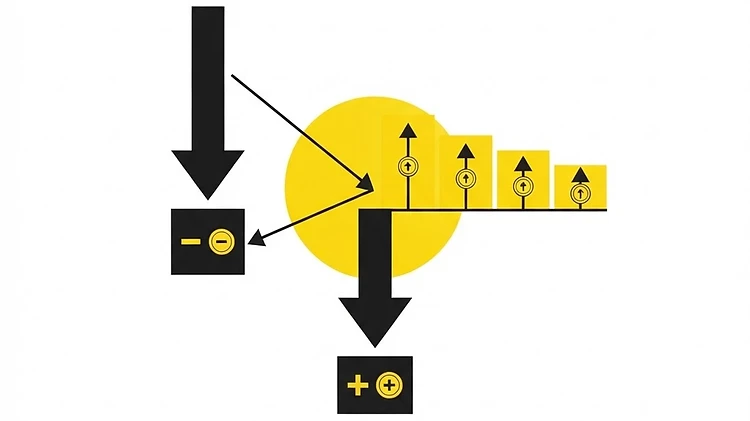
- A positive NPV indicates a project is worth pursuing, while a negative NPV suggests it will destroy value.
- NPV allows businesses to compare different investment options objectively by putting them on an equal footing.
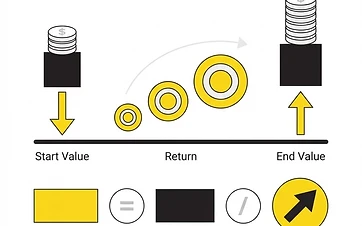
The Core Concept: Money Today Beats Money Tomorrow Imagine someone offers you a choice: they can give you 1,000 dollars today, or they can give you 1,000 dollars exactly five years from now. Which would you choose? Most people instantly pick the cash today. Why? It is not just about impatience; it is about the Time Value of Money. Money you have now is worth more than the same amount in the future because you could invest the money today and earn interest. Additionally, future money is uncertain and can be eroded by inflation. In business, this is the foundation of investment appraisal. When we decide whether to buy a new machine or launch a new store, we need to compare costs spent now with future profits. This is where Net Present Value (NPV) comes in. ## Understanding Discounting To compare future cash flows with today's money, we use a process called 'discounting.' Discounting effectively reverses the effect of interest. It allows us to calculate the 'Present Value' (PV) of future earnings. The rate we use to discount is called the discount rate, which usually represents the opportunity cost of capital or the interest rate a business could earn elsewhere. Think of it as a penalty we apply to future money to bring it back to a level playing field with today's currency. ## The NPV Calculation Let us look at a practical example. Imagine a local artisanal bakery called 'Crust & Crumb.' They are considering buying a new automated dough-mixer that costs 5,000 dollars today. The mixer is expected to generate 3,000 dollars in extra profit at the end of year one and 3,000 dollars at the end of year two. The bakery uses a discount rate of 10 percent. The formula for NPV is: NPV = Sum of Present Values of inflows minus the initial cost. The Present Value formula is: PV = Future Cash Flow divided by (1 + r) to the power of n, where 'r' is the discount rate and 'n' is the year. For the dough-mixer: Year 1 PV: 3,000 / (1.10)^1 = 2,727.27 dollars. Year 2 PV: 3,000 / (1.10)^2 = 2,479.34 dollars. Total Present Value of inflows: 2,727.27 + 2,479.34 = 5,206.61 dollars. NPV = 5,206.61 - 5,000 (the initial cost) = 206.61 dollars. ## Interpreting the Result When you run these numbers, the result tells a clear story. If the NPV is positive, the project adds value to the business and should generally be accepted. If the NPV is negative, it means the project is not earning enough to cover its cost of capital and should be rejected. Our bakery’s NPV of 206.61 dollars is positive, meaning the machine is a sound financial choice. It covers its own cost plus the opportunity cost of the capital invested. ## Key Terms - Time Value of Money: The principle that a unit of currency today is worth more than the same amount at a future date. - Discounting: The mathematical technique used to calculate the present value of future cash flows. - Discount Rate: The interest rate used to adjust future cash flows to their present value. - Net Present Value: The difference between the present value of cash inflows and the cost of an investment. ## Exam Tip Exam Tip: When calculating NPV, always remember to subtract the initial investment (outflow) at Year 0. Many students forget this step or accidentally include it in the discounting process, which leads to an incorrect final value. ## Comparing Alternatives Let us say Crust & Crumb considers a second option: a high-speed oven costing 6,000 dollars that promises 4,000 dollars in year one and 3,000 dollars in year two. Year 1 PV: 4,000 / 1.10 = 3,636.36 dollars. Year 2 PV: 3,000 / 1.21 = 2,479.34 dollars. Total PV = 6,115.70 dollars. NPV = 6,115.70 - 6,000 = 115.70 dollars. Both machines have positive NPVs, but the dough-mixer offers a higher net benefit. By using NPV, the business owners can objectively rank their choices rather than guessing based on raw profit totals. Business decisions are rarely about single numbers; they are about choosing the best path among many, and NPV provides the map. Keep working through these scenarios and soon these calculations will be second nature. Practice, Practice, Practice!
Discussion Questions
- What is the difference between simple profit and Net Present Value when evaluating an investment project?
- If a business decides to increase its discount rate, how does this change affect the NPV of its potential projects?
- To what extent is NPV a better tool for investment appraisal than simple payback methods for a growing small business?
Share