Payback Period: How Quickly Does an Investment Pay for Itself?
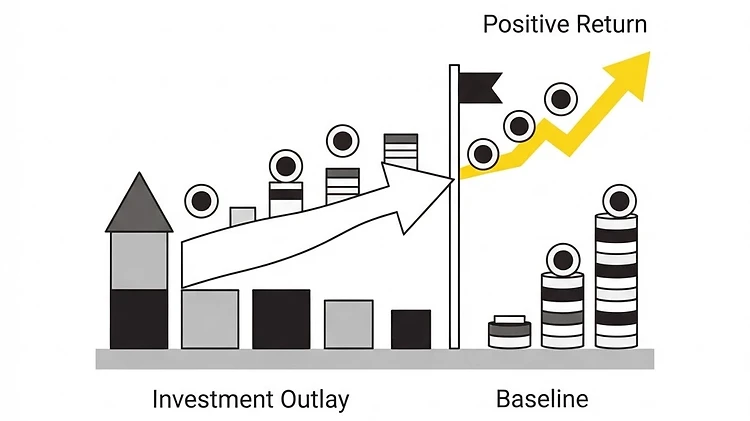
Key Takeaways
- The payback period measures how long it takes for an investment to cover its own initial cost.
- A shorter payback period is generally preferred by businesses prioritizing liquidity and risk reduction.
- The method is simple to calculate but ignores the time value of money and total long-term profitability.
- Managers should use payback periods alongside other appraisal methods to get a complete financial picture.
Understanding the Payback Period
Imagine you are running a small, thriving bakery called 'Crumbly Delights.' You have been rolling out dough by hand for years, but business is booming, and your wrists are tired. You are considering buying a high-tech electric dough mixer. It costs $10,000. It will save you time and help you sell more loaves, generating an extra $2,500 in profit every year. The question you face is simple yet critical: How long will it take for this machine to pay for itself? This is the core concept of the 'payback period.'
In business management, the payback period is an investment appraisal method that calculates the exact amount of time required for an investment to recover its initial cost from the cash flows it generates. It acts as a stopwatch for your capital, telling you exactly when the equipment or project starts truly 'paying you' rather than just breaking even.
The Formula
The calculation for the payback period is straightforward, provided the annual cash flows are consistent. The formula is: Payback Period = Initial Investment Cost / Annual Cash Flow.
Let’s apply this to 'Crumbly Delights.' With an initial cost of $10,000 and an annual cash flow of $2,500, we divide $10,000 by $2,500. The result is 4 years. This means after four years of using the mixer, the machine has essentially paid for itself, and any profit earned after that point is a bonus.
A Comparison: Machine A vs. Machine B
Now, let's say a local cafe, 'Bean & Brew,' is choosing between two different espresso machines to handle their growing morning rush. Machine A costs $12,000 and provides annual returns of $4,000. Machine B costs $15,000 but is more efficient, providing annual returns of $6,000.
For Machine A: $12,000 / $4,000 = 3 years. For Machine B: $15,000 / $6,000 = 2.5 years.
If the owner only looks at the payback period, Machine B is the clear winner because it pays for itself six months faster than Machine A. However, choosing an investment based solely on speed can sometimes be a trap.
Advantages of the Payback Method
The primary reason managers love the payback period is its simplicity. It is incredibly easy to calculate and explain to stakeholders who may not have a degree in finance. It also prioritizes liquidity, which is vital for small businesses. By focusing on how quickly cash returns to the business, you reduce the risk of having your capital tied up in a project for too long. If you are operating in a volatile market where technology changes rapidly, getting your money back quickly is a smart strategy to avoid being stuck with obsolete equipment.
Limitations to Consider
Despite its popularity, the payback period has significant flaws. First, it ignores the 'big picture' of profitability. A project might have a short payback period but generate very little total profit over its lifetime. Conversely, a project with a longer payback period might lead to massive profits in the long run.
Second, it completely ignores the time value of money. A dollar today is worth more than a dollar five years from now because today's dollar could be invested and grow. The payback period treats every dollar as if it has the same value, regardless of when it is received. Finally, it ignores any cash flows that happen after the payback point. If Machine A runs for ten years but Machine B breaks down after three years, the simple payback calculation fails to capture that long-term discrepancy.
Key Terms
- Investment Appraisal: The process of evaluating the profitability or viability of a business project or asset purchase.
- Payback Period: The length of time required for an investment to recover its initial cost through the cash it generates.
- Cash Flow: The total amount of money being transferred into and out of a business.
- Liquidity: The availability of liquid assets to a company, which helps it meet its short-term financial obligations.
Exam Tip: When answering questions on payback, always remember to show your units (e.g., years or months). If the answer is 2.5 years, clearly state that as 2 years and 6 months to demonstrate precision in your calculation.
Mastering investment appraisal is all about logic and careful math—keep practicing your calculations and you will be ready for any challenge!
Discussion Questions
- Define what is meant by the term 'payback period' in the context of capital investment.
- If a business invests $50,000 in a new delivery van that generates $12,500 in savings per year, how long is the payback period?
- To what extent is the payback period a reliable method for evaluating long-term business investments?