The Balance Sheet Explained: Assets, Liabilities, and Equity
Key Takeaways
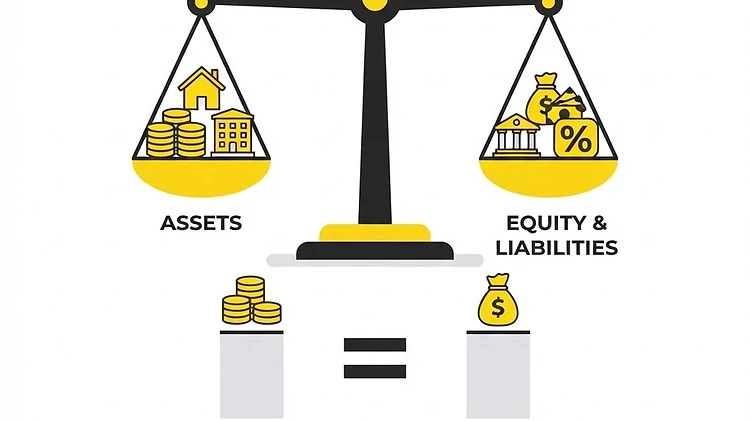
- The accounting equation states that Assets must always equal Liabilities plus Equity.
- Balance sheets are a static snapshot of financial health at a specific point in time.
- Assets represent what you own, while liabilities represent what you owe to others.
- Equity demonstrates the owner's true stake in the business after all debts are paid.
Understanding the Balance Sheet: A Snapshot of Success
Imagine you are running a business. At the end of the year, you need to know exactly where you stand. You need to know what you own, what you owe, and how much value is actually yours. This is where the balance sheet comes in. Think of it as a financial 'snapshot' taken on a single specific day, showing the financial health of your enterprise.
The Core Equation
At the heart of the balance sheet is the accounting equation: Assets = Liabilities + Equity. This must always be in balance. If you own something (Asset), you either bought it with borrowed money (Liability) or your own money (Equity).
Breaking Down the Components
Assets are everything the business owns that has monetary value. These are split into non-current assets (things kept for more than a year, like machinery or buildings) and current assets (things meant to be turned into cash within a year, like stock or cash in the bank).
Liabilities are the obligations the business has to pay out. Like assets, these are split by time. Long-term liabilities are debts due after more than a year, like bank loans. Current liabilities are debts that must be settled quickly, such as unpaid bills to suppliers.
Equity represents the owner's stake. It is the money originally invested by the owners plus any profit the business has made and retained over the years. It is effectively what would be left if you sold all your assets and paid off all your debts.
A Snapshot of 'Sunny Day Surfboards'
Let’s look at a fictional business, 'Sunny Day Surfboards.' At the end of the financial year, the owner prepares a balance sheet.
- Non-Current Assets (Workshop Equipment): $50,000
- Current Assets (Surfboard Inventory): $15,000
- Current Assets (Cash in Bank): $5,000
- Total Assets: $70,000
Now, look at the liabilities and equity:
- Current Liabilities (Unpaid Raw Materials): $5,000
- Long-term Liabilities (Bank Loan): $25,000
- Equity (Owner's Investment + Retained Profit): $40,000
- Total Liabilities + Equity: $70,000
The math holds up perfectly: $70,000 in assets equals $70,000 in claims against those assets. This tells us that Sunny Day Surfboards is currently funding its growth through a mix of debt ($30,000) and its own financial resources ($40,000).
Reading the Balance Sheet
When you read a balance sheet, look for liquidity—the ability to pay short-term bills. If the 'Current Assets' are significantly higher than 'Current Liabilities,' the business is in a good position to handle emergencies. Conversely, if 'Long-term Liabilities' are growing too quickly relative to 'Equity,' the business might be becoming too dependent on debt, which increases the risk of financial instability.
Key Terms
- Assets: Items of value owned by the business.
- Liabilities: Financial debts or obligations owed by the business to third parties.
- Equity: The residual value of the business belonging to the owners.
- Liquidity: The ease with which an asset can be converted into cash to pay off debts.
- Retained Profit: Profits earned by the company that are kept within the business rather than paid out to owners.
Exam Tip: Always remember that the balance sheet is a static document. It represents the financial position at a single point in time, not a summary of trading activity over the entire year like an income statement does.
By mastering the balance sheet, you are learning to read the story behind the numbers. Every transaction changes the balance, and understanding that flow is the first step toward financial literacy. Keep looking at different examples and you will soon spot trends effortlessly. Practice, practice, practice!
Discussion Questions
- What is the fundamental difference between a current asset and a non-current asset?
- If a company suddenly buys new machinery using cash, how does that change the balance sheet items?
- Evaluate the importance of the balance sheet for a bank considering whether to lend money to a small business.