Choosing a Location: What Every Local Business Should Weigh

Key Takeaways
- Location decisions involve trade-offs between rent, visibility, and accessibility.
- Weighted averages help objectively compare different business sites.
- Proximity to suppliers and customers significantly impacts operational efficiency.
- Relocation is a strategic move to be made when current sites no longer support profitability.
Finding the Perfect Home for Your Business
Imagine you are starting 'Velocity Cycles,' a bike shop specializing in urban mountain bikes. You have found two perfect storefronts, but they are miles apart in terms of strategy. One is in a quiet, low-rent industrial district, and the other is right in the heart of the bustling City Plaza. Which one do you pick? Choosing a location is one of the most critical decisions an entrepreneur makes, as it acts as the foundation for your operational success.
The Big Factors to Consider
First, think about customers. If your bike shop relies on foot traffic and impulse buys, the City Plaza location is a clear winner. However, if your business is niche and people seek you out specifically, you might save money by choosing a location that is slightly 'off the beaten path.'
Next, look at your suppliers. Do you need frequent deliveries? If your supplier is located on the other side of the country, transport costs will eat into your profits. Proximity to suppliers keeps lead times low and logistical headaches to a minimum.
Competition is another major factor. Are you looking to cluster with similar businesses to become a 'destination' for shoppers, or do you want to be the only bike shop for miles? Sometimes, being near a rival can actually help by pulling in more target customers, but you must be prepared to compete on price, service, or quality.
Finally, don't overlook costs. It is not just the rent. You must factor in utility bills, local business taxes, and the cost of renovating the space. Let's look at the numbers to see how we weigh these choices.
A Worked Example: Velocity Cycles
Let’s compare Site A (Industrial District) and Site B (City Plaza) for Velocity Cycles. We use a simple Weighted Average Table to decide.
| Factor | Weight | Score A (1-5) | Total A | Score B (1-5) | Total B | | :--- | :--- | :--- | :--- | :--- | :--- | | Rent Cost | 0.4 | 5 | 2.0 | 2 | 0.8 | | Foot Traffic | 0.3 | 2 | 0.6 | 5 | 1.5 | | Parking | 0.3 | 4 | 1.2 | 1 | 0.3 | | Total | 1.0 | | 3.8 | | 2.6 |
Calculation: (Weight × Score) = Total. For Rent at Site A: 0.4 × 5 = 2.0.
Interpretation: Site A scored 3.8, while Site B scored 2.6. Even though Site B has more foot traffic, the weight we assigned to rent cost (0.4) makes Site A the more viable choice for a new business needing to protect its cash flow.
Relocating or Reorganizing: Knowing When to Move
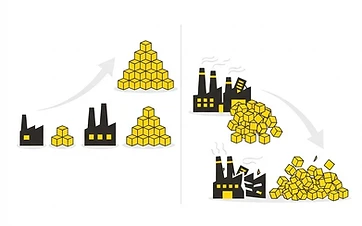
Sometimes, a location that worked yesterday doesn't work today. If your target market moves to the suburbs, or if your rent increases by 30% annually, you might consider relocating. Relocating is expensive and disruptive, but sometimes it is the only way to remain profitable in a changing market. Alternatively, you might 'reorganize production' by keeping the storefront but moving the repair workshop to a cheaper warehouse location nearby, optimizing your space usage.
Key Terms
- Foot Traffic: The volume of potential customers passing by a storefront.
- Lead Time: The total time between ordering a product and receiving it.
- Relocation: The process of moving a business to a different geographical site.
- Weighted Average: A method of decision-making that assigns importance (weight) to different criteria.
Exam Tip: When discussing location decisions, always mention the trade-offs. No site is perfect; you are almost always trading off high rent for high visibility or lower costs for lower accessibility.
Success in business is rarely about finding the 'perfect' place; it is about choosing the best place for your specific goals. Practice, practice, practice!
Discussion Questions
- Define what is meant by 'foot traffic' and explain why it might be more important for some businesses than others.
- Using the weighted average method, explain how you would rank a new location if your primary goal shifted from 'saving money' to 'maximizing brand exposure'.
- Evaluate whether relocating a business is always a better solution than attempting to reorganize existing production processes.