Just-in-Time vs. Just-in-Case: Managing Inventory Without Going Crazy
Key Takeaways
- Just-in-Time focuses on efficiency and minimizing waste but carries high supply chain risk.
- Just-in-Case prioritizes resilience by maintaining buffer stocks to handle unforeseen disruptions.
- Reorder levels are calculated using lead time and usage rates to ensure continuity.
- Operations management is a trade-off between cost, speed, and reliability.
The Balancing Act of Inventory
In the world of operations management, inventory is often viewed as a necessary evil. Hold too much, and you waste cash on storage and risk obsolescence. Hold too little, and you risk a stockout that leaves customers walking out the door. At the heart of this dilemma lie two competing philosophies: Just-in-Time (JIT) and Just-in-Case (JIC).
Just-in-Time: Efficiency at the Limit
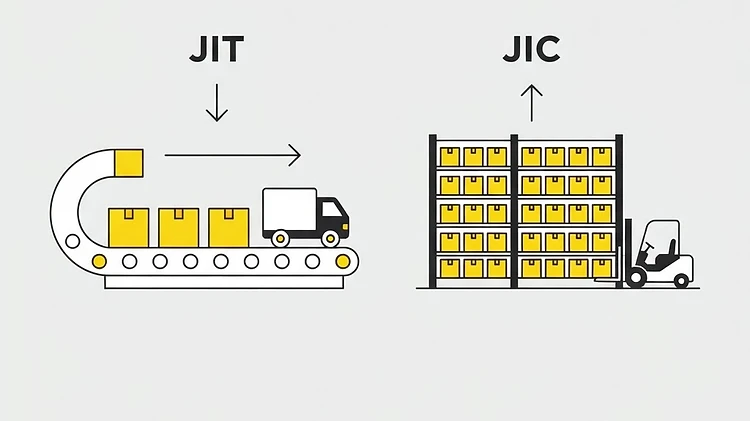
JIT is the lean approach. The goal is to receive stock only as it is required for production or sale. Consider 'FreshStep Grocers,' a trendy boutique store. By operating on a JIT model, FreshStep orders its artisan sourdough bread to arrive exactly thirty minutes before the store opens. Because the bread is delivered fresh and sold immediately, FreshStep saves money on rent for a large storage warehouse and minimizes the risk of moldy or unsold loaves.
However, JIT is fragile. If the delivery truck breaks down, FreshStep has zero inventory to sell. They rely entirely on a seamless supply chain. In our interconnected global economy, a single disruption at a port can bring a JIT system to a grinding halt.
Just-in-Case: The Safety Net
JIC is the traditional approach. Businesses maintain buffer stocks to shield themselves from supply chain volatility. Let’s look at 'MegaMart Depot,' a warehouse-style retailer. They keep an extra three weeks of canned goods on the shelves. When a massive winter storm hits, delaying all shipments for ten days, MegaMart continues to operate normally. While their storage costs are higher than FreshStep’s, they possess the resilience to survive shocks that would crush a leaner competitor.
Measuring Your Safety: Buffer Stock and Reorder Levels
For HL students, understanding the math behind stock control is vital. You cannot rely on guessing. To keep operations running smoothly, managers use the reorder level formula:
Reorder Level = (Maximum Daily Usage × Maximum Lead Time) + Buffer Stock
Let’s apply this to 'Apex Electronics,' a company selling high-end gaming consoles. Suppose they sell a maximum of 10 consoles per day. The supplier takes a maximum of 5 days to deliver. Apex decides to hold 20 consoles as buffer stock to account for unpredictable demand surges.
Calculation: (10 units/day × 5 days) + 20 units = 70 units.
Interpretation: When the stock drops to 70 units, Apex must place a new order. This ensures that even if the supplier is late or customers buy consoles faster than usual, Apex will not run out before the new shipment arrives. The buffer stock acts as the critical safety cushion.
The Trade-offs
Choosing between JIT and JIC is not about picking the 'best' method, but about understanding your risk profile. JIT reduces costs and minimizes waste, adhering to lean manufacturing principles. However, it requires highly reliable suppliers and excellent communication. JIC allows for rapid response to demand spikes and protects against supplier failure, but it ties up working capital in stagnant goods that could have been used for marketing or expansion.
Key Terms
- Buffer Stock: The extra inventory held to protect against unexpected demand surges or supply delays.
- Lead Time: The time duration between placing an order and receiving the delivery.
- Just-in-Time (JIT): An inventory management strategy where stock arrives only as needed, minimizing storage costs.
- Reorder Level: The specific quantity of stock at which a new order must be placed to avoid running out.
- Lean Production: An approach to management that focuses on cutting waste while maintaining quality.
Exam Tip: When discussing JIT and JIC in your essays, never argue that one is universally superior. Always contextualize your answer by mentioning the reliability of the supplier, the nature of the product, and the financial stability of the business. An HL response must consider how a change in external factors, like a global crisis, might shift a firm's strategy.
Ultimately, supply chain management is about making calculated choices. You must decide whether your business values the thin margins of efficiency or the solid peace of mind that comes with a safety net. Whether you are managing a small bakery or a global logistics firm, the principles remain the same. Master the calculations, evaluate the risks, and keep your business running smoothly by putting in the hours. Practice, Practice, Practice!
Discussion Questions
- What are the primary differences between the JIT and JIC inventory management systems?
- If 'FreshStep Grocers' switched to a JIC model, how would their balance sheet and cash flow be affected?
- To what extent is Just-in-Time appropriate for a business operating in a politically unstable region?