Crisis Management vs. Contingency Planning: Be Ready Before It Happens
Key Takeaways
- Contingency planning is proactive and prepares for foreseeable risks.
- Crisis management is reactive and requires rapid, transparent communication.
- Expected Value (EV) helps businesses weigh the financial impact of potential risks.
- Effective crisis response focuses on leadership and stakeholder trust.
Crisis Management vs. Contingency Planning: Be Ready Before It Happens
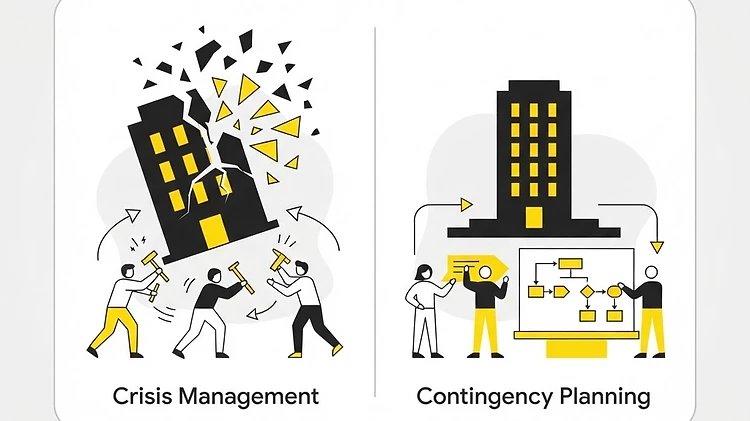
In the fast-paced world of business, the unexpected is the only constant. Whether you are a small startup or a global corporation, you will eventually face a disruption. As a business student, it is vital to distinguish between two key strategies: contingency planning and crisis management. Think of contingency planning as your map for expected roadblocks, and crisis management as your emergency response when the ground shifts beneath your feet.
The Concept of Contingency Planning
Contingency planning is a proactive strategy. It involves identifying potential threats to a business and creating a structured plan to mitigate them. By anticipating these risks, companies can reduce the financial and operational impact of negative events.
Consider 'The Savory Spoon', a high-end restaurant in a busy city center. They know their kitchen relies on a complex gas-powered ventilation system. A fire in this area would stop all operations. By developing a contingency plan, they have pre-signed contracts with a backup service provider, a clear evacuation route for staff, and an insurance policy specifically for kitchen-related disasters. They are not waiting for the fire; they are prepared for the possibility of one.
Crisis Management: When the Map Fails
Crisis management is reactive. It is the application of strategies designed to help an organization deal with a sudden, significant, and negative event. While you can plan for some crises, others are unpredictable or escalated to a level where standard protocols no longer apply.
Imagine that 'The Savory Spoon' is hit with a viral social media post claiming a massive health violation that didn't actually happen. This is a PR crisis. Their contingency plan for a kitchen fire won't help them here. Crisis management requires quick, decisive communication, honesty, and a focus on reputation recovery. Effective crisis responses rely on three pillars: Transparency, Speed, and Responsibility.
Measuring Risk: The Expected Value (EV)
In IB Business Management, we often use Expected Value (EV) to quantify risk during the contingency planning phase. EV is the weighted average of all possible outcomes.
Formula: EV = (Probability of Outcome 1 x Financial Result 1) + (Probability of Outcome 2 x Financial Result 2)
Let’s apply this to 'The Savory Spoon'. They face two potential scenarios for their upcoming summer festival: Scenario A: Perfect weather (80% probability) leading to $50,000 profit. Scenario B: Stormy weather (20% probability) leading to a $10,000 loss.
EV = (0.80 * $50,000) + (0.20 * -$10,000) EV = $40,000 - $2,000 = $38,000
Interpretation: The EV of $38,000 provides the restaurant with a realistic financial expectation, allowing them to allocate resources for potential losses while planning for growth.
What Makes a Crisis Response Effective?
- Swift Communication: Silence is often interpreted as guilt. Organizations must speak first and speak accurately.
- Strong Leadership: A single, calm, and authoritative voice is essential to reduce panic among stakeholders.
- Mitigation of Damage: Acting fast to fix the problem—whether it is a faulty product or a PR disaster—is more important than assigning blame.
Key Terms
- Contingency Planning: Proactive preparation for identified potential threats.
- Crisis Management: The reactive process of responding to sudden, damaging events.
- Stakeholders: Anyone with an interest in the business, including customers, employees, and investors.
- Business Continuity: The capability of an organization to continue providing products or services at acceptable levels following a disruption.
Exam Tip: When asked about crisis management in an exam, always discuss the impact on stakeholders. A poor crisis response doesn't just lose money; it destroys brand loyalty, which is far harder to regain.
Preparation turns chaos into a managed problem. Keep honing your skills, because in business, it is all about practice, practice, practice!
Discussion Questions
- What is the difference between a foreseeable risk and an unforeseen crisis?
- How could The Savory Spoon use a contingency plan to minimize losses if their main supplier suddenly went bankrupt?
- Evaluate the necessity of a dedicated crisis management team versus an ad-hoc response in a global business.