Economies and Diseconomies of Scale: When Bigger Is (and Isn't) Better
Key Takeaways
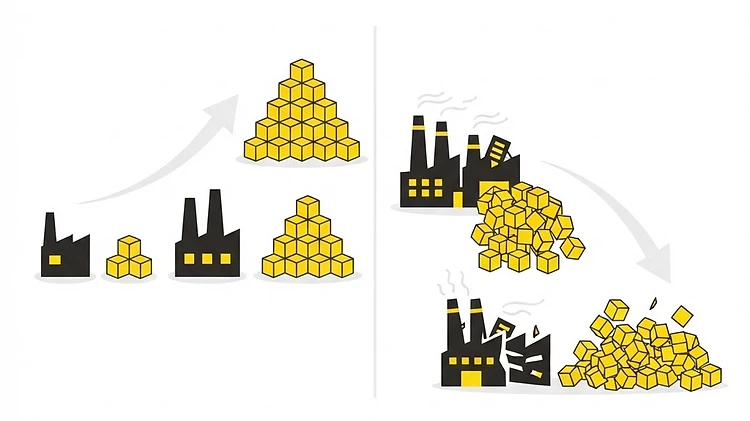
- Economies of scale lead to lower average costs as production volume increases.
- Purchasing, technical, and financial efficiencies are key drivers of growth benefits.
- Diseconomies of scale arise from communication gaps, poor management, and excessive bureaucracy.
- Businesses must identify their optimal size to maintain the lowest possible average cost per unit.
Growing Pains and Gains: The Scale Story
Imagine you are the proud owner of 'PrintPerfect', a small shop that creates custom wedding invitations and business flyers. At the moment, you do everything yourself with one basic printer. As you start to get more orders, you realize you are working late into the night. You have two choices: stay small or grow. In IB Business Management, we look at the concept of 'economies of scale' to decide if that growth is a smart move.
Economies of Scale: The Efficiency Boost
Economies of scale occur when the average cost of producing one unit decreases as the total output increases. Think of it as a 'bulk discount' for your business operations. When PrintPerfect moves from one printer to ten, we start seeing benefits.
Purchasing economies are the first perk. If you buy paper by the box, you pay a premium price. If you buy by the truckload, the supplier gives you a massive discount. Technical economies also kick in; with ten printers, you can assign one staff member to specialize in maintenance, making the workflow much smoother. Finally, there are financial economies. A bank is much more likely to offer a low-interest loan to an established, growing business like PrintPerfect than to a tiny, risky startup.
Calculating the Average Cost
To understand this, we use the formula: Average Cost = Total Cost / Total Output. Suppose PrintPerfect spends $1,000 a week on rent, salaries, and materials to produce 100 invitations. The average cost per invitation is $10 ($1,000 / 100). If you scale up and your total cost becomes $4,000 for 500 invitations, your new average cost is $8 ($4,000 / 500). By increasing your scale, you have successfully lowered the cost per unit by $2. This means you can either keep more profit or lower your price to beat your competition.
Diseconomies of Scale: When Bigger Gets Messy
However, growth is not always sunshine and rainbows. Diseconomies of scale happen when a firm becomes so large that its average costs start to rise again. If PrintPerfect expands to 50 locations, the management might lose touch. This is called a communication breakdown. Managers might spend all day in meetings instead of overseeing quality, and employees might feel like just a number, leading to lower motivation.
Managerial issues are common. In a small shop, you make all the decisions in seconds. In a giant corporation, a simple decision to change a paper supplier might need to go through three committees and a board vote. This bureaucracy slows everything down and wastes money. Furthermore, if the workspace becomes too crowded, staff might get in each other's way, leading to errors and wastage, which drives costs back up.
Finding the Sweet Spot
Every business has an 'optimal' size. The goal is to grow enough to capture the efficiencies of scale but stop or adjust before the communication and management problems of diseconomies of scale set in. For PrintPerfect, this might mean having three regional hubs rather than 50 tiny kiosks. Successful business owners are always watching their average cost data to ensure they stay in that 'sweet spot' where costs are as low as possible.
Key Terms
- Economies of Scale: The cost advantages a business gains due to an increase in the scale of production.
- Diseconomies of Scale: The disadvantages or rising average costs that occur when a business grows too large.
- Average Cost: The total production cost divided by the quantity of units produced.
- Bulk Buying: A form of purchasing economy where buying in large quantities reduces the cost per unit.
- Bureaucracy: Excessive administrative rules and processes that can slow down decision-making in large organizations.
Exam Tip: When an exam question asks about scale, always link your answer to the impact on the 'average cost' per unit. Do not just say the business makes 'more money'; explain how lower costs improve their profit margins or competitive pricing power.
Understanding these dynamics is the first step toward becoming a strategic thinker in the world of business. Keep analyzing the numbers, keep questioning the systems, and remember that real mastery comes from consistent, deliberate practice. Practice, practice, practice!
Discussion Questions
- What is the difference between an economy of scale and a diseconomy of scale?
- How might a small local bakery use bulk-buying to achieve economies of scale?
- Evaluate the potential risks a rapidly growing technology startup faces as it transitions from a small team to a large multinational corporation.