Sole Trader, Partnership, or Company? Choosing the Right Business Structure
Key Takeaways
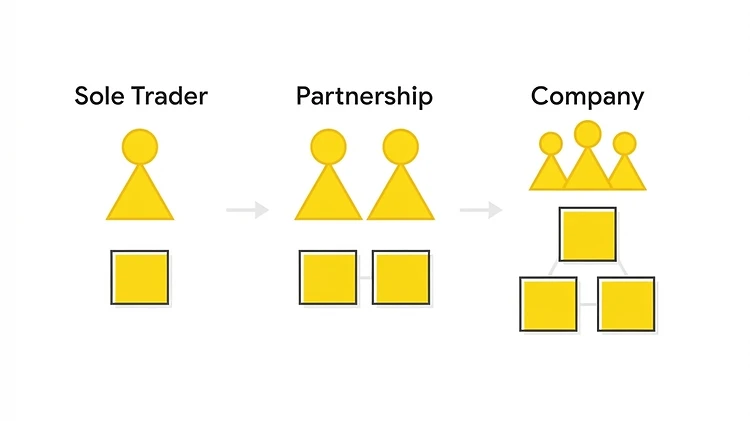
- Sole traders enjoy total control but face unlimited liability.
- Partnerships allow for shared expertise but risk internal conflict.
- Companies provide limited liability, protecting personal assets of shareholders.
- The private sector focuses on profit, while the public sector focuses on service.
Choosing the Right Path for Your Business
Imagine you are Leo, a talented landscaper who has spent the last few years working solo under the name 'Leo’s Lush Lawns.' You have built a loyal client base, but your business is growing fast. You are now considering hiring staff, buying expensive machinery, and potentially taking on larger commercial contracts. This growth brings a crucial question: is your current business structure still the best one, or is it time to evolve?
The Sole Trader: Starting Simple
As a sole trader, Leo is the business. This is the simplest structure, common for freelancers and small service providers. The biggest advantage is total control; Leo makes every decision without consulting anyone. The setup costs are minimal, and there is minimal legal paperwork. However, the dark side is unlimited liability. If 'Leo’s Lush Lawns' gets sued or fails to pay a supplier, Leo is personally responsible for all debts. His personal assets, like his car or savings, could be seized to settle business debts.
Partnerships: Sharing the Load
As Leo expands, he might ask his friend Sarah, an expert designer, to join him as a partner in 'Leo and Sarah Landscapes.' A partnership allows them to share the financial burden and combine their skills. They can create a deed of partnership to outline roles and profit sharing. While this spreads the risk, they still generally face unlimited liability. Furthermore, disagreements between partners can lead to gridlock, potentially damaging the business.
Becoming a Company
If the business grows even further, Leo might decide to incorporate, creating 'Lush Lawns Ltd.' This creates a 'separate legal entity.' The company exists independently from its owners, known as shareholders. The most significant benefit here is limited liability. If the company fails, the shareholders only lose the money they invested, not their personal homes or vehicles.
Calculating Financial Stakes: A Quick Example
To understand the financial implications, let’s look at the basic profit allocation. If 'Leo and Sarah Landscapes' makes a profit of $50,000 and they have a 60/40 profit-sharing agreement, the calculation is simple:
Formula: Profit share = Total Profit x Agreed Percentage Leo’s share: $50,000 x 0.60 = $30,000 Sarah’s share: $50,000 x 0.40 = $20,000
This simple formula shows how partners distribute rewards based on their agreement. If they were a company, they might retain this profit within the business to fund new equipment rather than paying it out, demonstrating how different structures impact cash flow.
Private vs. Public Sector
'Lush Lawns Ltd' is part of the private sector, where businesses are owned by individuals aiming for profit. Contrast this with the public sector, where organizations like local government parks departments are owned by the state. These public organizations aim to provide services to the community rather than making a profit for private owners. Understanding this distinction is vital for analyzing the goals of any organization you study.
Key Terms
- Unlimited Liability: A situation where the owner is personally responsible for all business debts.
- Limited Liability: A status where shareholders are only liable for the amount they have invested in the company.
- Sole Trader: A business owned and operated by one person.
- Separate Legal Entity: A business structure that is legally distinct from its owners.
- Private Sector: Businesses owned and controlled by individuals or groups of individuals.
Exam Tip: When an exam question asks you to recommend a business structure, always mention the trade-off between control and risk. For example, explain how a sole trader gains control but loses the safety net of limited liability.
Your business journey is just beginning, and mastering these concepts is your first step toward success—keep practicing your analysis!
Discussion Questions
- What are the primary differences between unlimited and limited liability?
- If Leo wanted to expand into national operations, why might incorporating into a company be a better choice than remaining a sole trader?
- Evaluate the decision for a small business to transition from a sole trader to a private limited company.