Why Some Businesses Choose to Stay Small
Key Takeaways
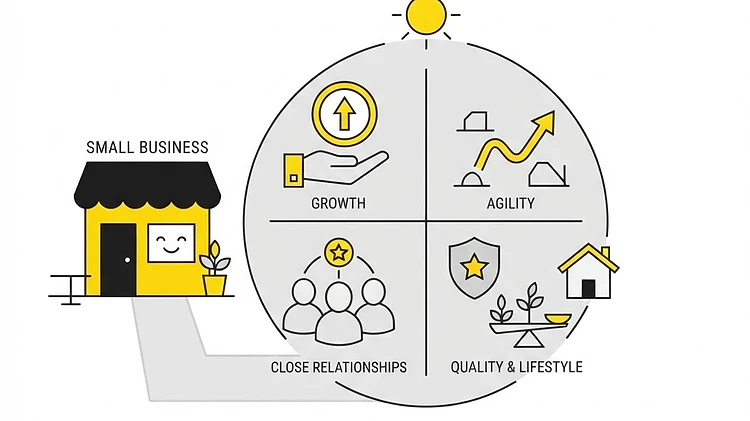
- Growth is a strategic choice, not an inherent requirement for business success.
- Small businesses often retain competitive advantages through superior customer service and niche market focus.
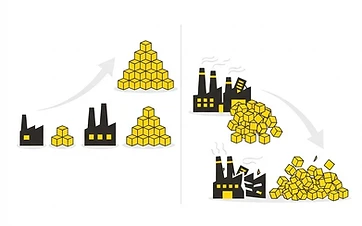
- Expansion can lead to diseconomies of scale, such as communication issues and decreased quality control.
- Financial metrics like ROI must be weighed against the qualitative costs of losing personal control and autonomy.
The Art of Staying Small
When we talk about business growth in an IB classroom, the conversation often centers on expansion, global markets, and economies of scale. It is easy to assume that 'bigger is always better.' However, growth is a choice, not an obligation. For many entrepreneurs, staying small is a strategic decision rooted in values, quality control, and personal lifestyle.
The Bakery Dilemma: Growth vs. Autonomy
Consider 'Sunny Crumb Bakery,' a beloved local spot founded by Elena. Her sourdough bread is famous across town, and her shop is always bustling. Recently, a venture capital firm approached Elena with a tempting offer: provide the capital and management expertise to turn Sunny Crumb into a franchise with fifty locations across the country. Elena thought about it, but ultimately declined. Why? Because she realized that expansion would mean outsourcing her baking to centralized factories, replacing her hands-on recipes with standardized, mass-produced ingredients, and spending her days in boardrooms rather than her kitchen. For Elena, the 'size' of her profit was less important than the 'quality' of her craft.
Why Businesses Choose to Stay Small
There are several valid reasons why a firm might avoid rapid growth. First, there is the desire to maintain a niche market focus. By staying small, a business like Sunny Crumb can offer a highly personalized customer experience that global chains cannot replicate. Second, owners often prioritize financial independence. Growth often requires heavy borrowing or selling equity to shareholders, which reduces the founder's control. Third, staying small helps avoid the 'diseconomies of scale,' such as communication breakdowns, slow decision-making, and low staff morale that often plague large organizations.
Understanding the Math of Expansion
If you are evaluating growth, you must understand the costs. One common metric is 'Return on Investment' (ROI). Let us assume Elena considered a smaller expansion: buying a new, larger oven for $10,000 to increase her monthly profit by $2,000.
Formula: ROI = (Net Profit / Cost of Investment) × 100
Calculation: ($2,000 / $10,000) × 100 = 20%
Interpretation: For every dollar Elena invests in the new oven, she earns a 20% return. While this looks good on paper, Elena must also factor in the 'opportunity cost'—the time she will spend training staff to use the oven instead of perfecting her secret croissant recipe.
The Trade-offs of Growth
Growth is not inherently bad. Expanding offers economies of scale, allowing businesses to buy ingredients in bulk, which lowers the cost per unit. It provides brand awareness and a wider customer base, which can act as a buffer against market downturns. The trade-off is the loss of 'personal touch' and the increased burden of complex management. A small team works like a family; a corporation of thousands works like a machine. Both models function, but they serve different goals.
Key Terms
- Diseconomies of Scale: The disadvantages that arise when a business becomes too large, leading to inefficiencies.
- Economies of Scale: Cost advantages that enterprises obtain due to their scale of operation.
- Niche Market: A small, specialized segment of a market for which a specific product is focused.
- Stakeholder: Any individual or group that has an interest in the performance of the business.
Exam Tip: When writing an exam answer about growth, do not simply list the benefits. Always discuss the specific context of the business; for instance, mention how rapid expansion might conflict with the 'objectives' of the owner or the 'corporate culture' of the firm.
Finding the right balance is the core of great business management. Keep exploring these concepts and remember: practice, practice, practice!
Discussion Questions
- What are three potential non-financial objectives that might motivate an entrepreneur to keep their business small?
- If Sunny Crumb Bakery decided to expand, how might their 'Corporate Social Responsibility' strategy change compared to their current local model?
- Evaluate the decision for a local business to remain small rather than seeking rapid growth through franchising.